Key Takeaways
- Arteriosclerosis means artery walls have become thicker, harder, or less flexible over time.
- Atherosclerosis is one type of arteriosclerosis where plaque builds inside the artery wall.
- Plaque can narrow blood flow and raise the risk of heart attack or stroke.
- Stiff arteries can strain the heart even when major plaque buildup is not present.
- These terms overlap, but they should not be used as the same diagnosis.
Basic Meaning
Arteriosclerosis is the broad term. It means the arteries have become thicker, harder, or less flexible.
Healthy arteries stretch with each heartbeat. They help move blood forward without forcing the heart to push against too much pressure. When arteries become stiff, they lose some of that normal stretch.
Arteriosclerosis can happen with age, high blood pressure, diabetes, kidney disease, and other long term stress on the artery wall (1, 2).
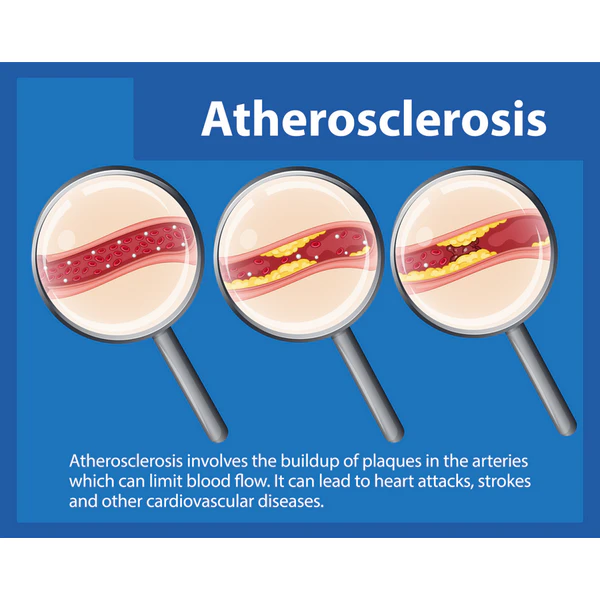
Atherosclerosis is one type of arteriosclerosis. It means plaque has formed inside the artery wall.
Plaque can contain fat, cholesterol, calcium, cell waste, and immune cells. Over time, plaque can narrow the artery opening. Some plaque can also become unstable and trigger a clot (3, 4).
Arteriosclerosis means artery hardening in a broad sense. Atherosclerosis means plaque disease inside the arteries.
Broad Term & Plaque Form
Arteriosclerosis
Arteriosclerosis describes the condition of the artery wall. The wall becomes thicker, harder, and less able to stretch.
This can affect large arteries. It can also affect smaller arteries. It can involve stiffness, wall thickening, and calcium changes in the vessel wall.
A person can have arteriosclerosis without heavy plaque buildup. The artery may be stiff even when the blood channel is still fairly open.
Atherosclerosis
Atherosclerosis describes plaque buildup inside the artery wall. It is one specific form of arteriosclerosis.
Plaque starts in the inner layer of the artery. The artery lining becomes disturbed. Lipids and immune cells collect in that area. The body reacts with inflammation. Over time, plaque forms.
Some plaques stay stable for years. Other plaques can break open. When plaque breaks open, the body may form a clot at that spot. A clot can suddenly block blood flow to the heart or brain (5, 6).
The Main Difference
Arteriosclerosis describes hard or stiff arteries.
Atherosclerosis describes plaque inside arteries.
The two can happen together. Many people with plaque disease also have some artery stiffness. The words still do not mean the same thing.
Your body determines your ideal cholesterol level
Trying to artificially lower your cholesterol is not healthy.
Changes Inside Arteries
Stiff Artery Walls
Arteries are supposed to expand and recoil. This movement helps smooth blood pressure after each heartbeat.
With arteriosclerosis, the artery wall loses flexibility. The vessel may hold more stiff material and lose some elastic tissue. Blood pressure waves move faster through the artery when the wall becomes stiff.
This can raise pulse pressure. It can also make the heart work harder against the artery system (7, 10).
Plaque Buildup
With atherosclerosis, the main change is plaque. The plaque forms within the artery wall and can push into the channel where blood flows.
Plaque in heart arteries can reduce blood flow to the heart. Plaque in neck arteries can raise stroke risk. Plaque in leg arteries can reduce blood flow during walking.
The danger also depends on plaque stability. A small plaque can still cause harm if it breaks open and forms a clot.
Shared Drivers
Arteriosclerosis and atherosclerosis share many risk factors. These include aging, high blood pressure, smoking, diabetes, kidney disease, and long term metabolic stress.
Studies link arterial stiffness with later plaque formation and cardiovascular risk. That link does not make stiffness and plaque the same condition (8, 9).
One process focuses on the mechanics of the artery wall. The other focuses on plaque biology inside the artery wall.
Stronger Signal vs Weaker Signal
| Stronger signal | Weaker signal |
|---|---|
| Triglycerides | LDL alone |
| Blood pressure | Total cholesterol alone |
| Blood sugar | Single lab snapshot |
| Insulin resistance | Ignoring clot risk |
Testing & Diagnosis
Stiffness Testing
Arterial stiffness is often measured with pulse wave velocity. This test checks how fast pressure waves move through the arteries.
Faster wave speed usually means a stiffer artery wall. Aortic pulse wave velocity has been linked with future cardiovascular events and death in pooled studies (10, 7).
This kind of test asks how stiff the artery has become.
Plaque Imaging
Atherosclerosis is usually checked with imaging. Carotid ultrasound can look for plaque in the neck arteries. It can also measure intima media thickness.
Coronary calcium scans can show calcified plaque in the heart arteries. CT angiography can show plaque and narrowing in more detail.
Carotid intima media thickness and carotid plaque have been studied as markers of cardiovascular risk, but the result still needs proper medical context (11, 12).
This kind of test asks whether plaque is present, where it is, and whether it may affect blood flow.
Risk Marker Order
Symptoms & Risk
Silent Early Changes
Both conditions can develop for years without clear symptoms.
Arteriosclerosis may show up through rising blood pressure, wider pulse pressure, or signs of heart strain. One study linked systemic arteriosclerosis with left ventricular remodeling, while atherosclerosis did not show the same link (13).
Atherosclerosis may also stay silent for years. Symptoms often depend on where the plaque forms.
Plaque in the heart arteries can cause chest pressure. Plaque in the brain circulation can lead to stroke symptoms. Plaque in leg arteries can cause pain with walking that improves with rest.
Clear Word Use
Use arteriosclerosis when the main issue is hard, thick, or stiff arteries.
Use atherosclerosis when the main issue is plaque inside the artery wall.
A person can have both at the same time. This is common in older adults and in people with vascular disease.
The clean memory aid is direct. Arteriosclerosis means artery hardening. Atherosclerosis means plaque buildup.
For any health concerns or questions about a medical condition, get guidance from a physician or another appropriately trained clinician. Before changing your diet, supplements, or health routine, talk with a licensed healthcare professional.
Suggested Posts



Evidence Limits
Research
Mitchell, G.F. and Powell, J.T. (2020) ‘Arteriosclerosis: A Primer for “In Focus” Reviews on Arterial Stiffness’, Arteriosclerosis, Thrombosis, and Vascular Biology, 40(5), pp. 1025–1027. Available at: https://pubmed.ncbi.nlm.nih.gov/32320295/
Park, J.B. and Avolio, A. (2023) ‘Arteriosclerosis and Atherosclerosis Assessment in Clinical Practice: Methods and Significance’, Pulse (Basel), 11(1), pp. 1–8. Available at: https://pubmed.ncbi.nlm.nih.gov/37404379/
Dos Santos, V.P. et al. (2021) ‘Arteriosclerosis, atherosclerosis, arteriolosclerosis, and Monckeberg medial calcific sclerosis: what is the difference?’, Journal of Vascular Brasileiro, 20, e20200211. Available at: https://pubmed.ncbi.nlm.nih.gov/34290756/
Libby, P. (2021) ‘The changing landscape of atherosclerosis’, Nature, 592(7855), pp. 524–533. Available at: https://pubmed.ncbi.nlm.nih.gov/33883728/
Gimbrone, M.A. Jr and García-Cardeña, G. (2016) ‘Endothelial Cell Dysfunction and the Pathobiology of Atherosclerosis’, Circulation Research, 118(4), pp. 620–636. Available at: https://pubmed.ncbi.nlm.nih.gov/26892962/
Davignon, J. and Ganz, P. (2004) ‘Role of endothelial dysfunction in atherosclerosis’, Circulation, 109(23 Suppl 1), pp. III27–III32. Available at: https://pubmed.ncbi.nlm.nih.gov/15198963/
Vlachopoulos, C. et al. (2010) ‘Prediction of cardiovascular events and all-cause mortality with arterial stiffness: a systematic review and meta-analysis’, Journal of the American College of Cardiology, 55(13), pp. 1318–1327. Available at: https://pubmed.ncbi.nlm.nih.gov/20338492/
Palombo, C. et al. (2016) ‘Arterial stiffness, atherosclerosis and cardiovascular risk: Pathophysiologic mechanisms and emerging clinical indications’, Vascular Pharmacology, 77, pp. 1–7. Available at: https://pubmed.ncbi.nlm.nih.gov/26643779/
Oberoi, S. et al. (2013) ‘Progression of arterial stiffness and coronary atherosclerosis: longitudinal evaluation by cardiac CT’, American Journal of Roentgenology, 200(4), pp. 798–804. Available at: https://pubmed.ncbi.nlm.nih.gov/23521451/
Ben-Shlomo, Y. et al. (2014) ‘Aortic pulse wave velocity improves cardiovascular event prediction: an individual participant meta-analysis of prospective observational data from 17,635 subjects’, Journal of the American College of Cardiology, 63(7), pp. 636–646. Available at: https://pubmed.ncbi.nlm.nih.gov/24239664/
van den Oord, S.C.H. et al. (2013) ‘Carotid intima-media thickness for cardiovascular risk assessment: systematic review and meta-analysis’, Atherosclerosis, 228(1), pp. 1–11. Available at: https://pubmed.ncbi.nlm.nih.gov/23395523/
Willeit, P. et al. (2020) ‘Carotid Intima-Media Thickness Progression as Surrogate Marker for Cardiovascular Risk: Meta-Analysis of 119 Clinical Trials Involving 100 667 Patients’, Circulation, 142(7), pp. 621–642. Available at: https://pubmed.ncbi.nlm.nih.gov/32546049/
Weir-McCall, J.R. et al. (2018) ‘Systemic arteriosclerosis is associated with left ventricular remodeling but not atherosclerosis: a TASCFORCE study’, Journal of Cardiovascular Magnetic Resonance, 20(1), 7. Available at: https://pubmed.ncbi.nlm.nih.gov/29382349/
Yang, Y. et al. (2018) ‘Brachial-Ankle Pulse Wave Velocity is Associated with the Risk of New Carotid Plaque Formation: Data from a Chinese Community-based Cohort’, Scientific Reports, 8(1), 7037. Available at: https://pubmed.ncbi.nlm.nih.gov/29728607/
Li, W. et al. (2022) ‘Evaluation of Carotid Artery Atherosclerosis and Arterial Stiffness in Cardiovascular Disease Risk: An Ongoing Prospective Study From the Kailuan Cohort’, Frontiers in Cardiovascular Medicine, 9, 812652. Available at: https://pubmed.ncbi.nlm.nih.gov/35586658/
Lorenz, M.W. et al. (2007) ‘Prediction of clinical cardiovascular events with carotid intima-media thickness: a systematic review and meta-analysis’, Circulation, 115(4), pp. 459–467. Available at: https://pubmed.ncbi.nlm.nih.gov/17242284/
Weber, T. et al. (2004) ‘Arterial stiffness, wave reflections, and the risk of coronary artery disease’, Circulation, 109(2), pp. 184–189. Available at: https://pubmed.ncbi.nlm.nih.gov/14662706/
Cederqvist, J. et al. (2023) ‘Arterial stiffness and subclinical atherosclerosis in the coronary arteries at different stages of dysglycaemia’, Diabetic Medicine, 40(7), e15102. Available at: https://pubmed.ncbi.nlm.nih.gov/37004152/
Del Brutto, O.H. et al. (2020) ‘The association between aortic arterial stiffness, carotid intima-media thickness and carotid plaques in community-dwelling older adults: A population-based study’, Vascular, 28(4), pp. 405–412. Available at: https://pubmed.ncbi.nlm.nih.gov/32228175/
Bae, J.S. et al. (2013) ‘The impact of serum uric acid level on arterial stiffness and carotid atherosclerosis: the Korean Multi-Rural Communities Cohort study’, Atherosclerosis, 231(1), pp. 145–151. Available at: https://pubmed.ncbi.nlm.nih.gov/24125426/