Key Takeaways
- Bacteriophages are viruses that infect bacteria inside the gut.
- Gut phages can lower, move or change certain bacterial groups.
- Most gut phages infect bacteria instead of the cells lining the intestine.
- Phage research is useful, but treatment claims still need stronger human trials.
- A healthy gut depends on microbes, gut lining, immune signals and food quality.
Gut Phages
Bacteria Hosts
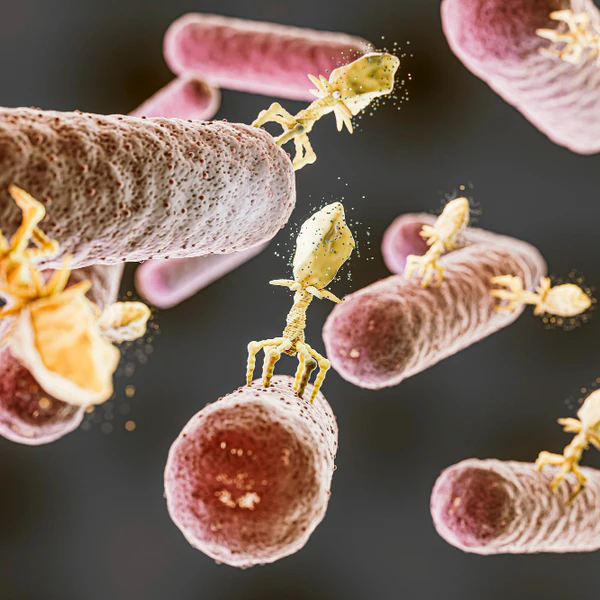
Bacteriophages are viruses that infect bacteria. The short name is phages. They live wherever bacteria live, including the mouth, skin, soil, water and intestine.
Your gut holds many viruses. Most of them are phages. They do not act like a cold virus because their usual target is a bacterial cell, not a human cell.
A review of the human gut virome describes phages as a major part of the gut virus community (1).
Each phage needs the right bacterial target. One phage may attach to one bacterial strain and leave nearby strains alone.
The match depends on the outer surface of the bacterium and the genes carried by the phage.
Gut health often gets discussed as if bacteria alone run the system. Phages add another layer. They can reduce certain bacteria, change bacterial behavior and move genes between bacteria.
Normal Residents
Some gut phages are common in healthy people. CrAss like phages are one known group. They often link with Bacteroidales bacteria, which are common in the human gut.
Researchers have found crAss like phages across human populations. These phages often appear after infancy as the gut becomes more adult like (2).
They are part of ordinary gut life for many people.
A phage can stay in the gut when its bacterial host stays there. It can drop when the host drops. Antibiotics, illness and major food changes can move the bacterial groups that phages depend on.
The gut virus community also contains many unknown viruses. Sequencing often finds viral genetic material that does not match known databases.
A 2023 review describes this unknown material as a major limit in gut virome research (3).
Bacterial Control
Direct Killing
Some phages enter bacteria, copy themselves and burst the cell open. The bacterium dies. New phages then move on to nearby bacteria.
That process can lower a bacterial group when the right phage and host meet. It also explains why researchers study phages as targeted tools.
A phage can hit a narrow bacterial target instead of wiping out broad groups at once.
This narrow action can be useful. It can also be limiting. The wrong phage will do little because it cannot attach to the wrong bacterium.
Phages can shape gut bacteria without acting like a broad cleaner. They work through close matches. The result depends on the bacteria already living in the gut.
Quiet Phages
Some phages enter bacteria and stay there. The bacterial cell keeps living while carrying phage genes. These quiet phage genes are called prophages.
Stress can wake up some prophages. Antibiotics, inflammation and other pressures can push a prophage into active copying.
A 2024 review describes prophages as one way phages can change gut bacteria and their contact with the immune system (4).
Prophages can also carry genes that change what bacteria do. Some genes can affect survival, toxin production or resistance traits. This can change the behavior of a bacterial group without removing it from the gut.
These changes help explain why gut phages deserve attention. They can kill bacteria. They can also change bacterial traits from inside the cell.
Gene Movement
Bacteria share genes in several ways. Phages can be one route for that movement. A phage can pick up genetic material from one bacterium and move it into another.
This matters in infection research because bacteria can gain traits that help them survive. It also matters in normal gut ecology because bacterial behavior affects the gut lining and immune contact.
A gut phage should not be viewed as good or bad by default. The effect depends on the bacterial host, the genes involved and the condition of the gut.
A phage linked to balance in one setting may be linked to trouble in another setting.
Gut Lining & Immunity
Mucus Layer
The gut lining is covered by mucus. This layer helps separate gut contents from the intestinal wall. Bacteria live near this layer, so phages live near it too.
Some researchers have proposed that phages in mucus may help control bacteria close to the gut surface.
This idea is still being tested. It makes sense because phages are most useful where their bacterial hosts are found.
The mucus layer is a busy border. Food, microbes and immune signals meet there every day. Phages can affect that space by changing which bacteria grow near the gut wall.
Immune Contact
Phages usually infect bacteria, but the immune system can still notice them.
The gut lining meets phage particles and bacterial material released during phage activity. Immune cells may respond to both.
A review in International Journal of Molecular Sciences described links between phages, gut bacteria and immune signaling, while noting that many human questions remain open (5).
Phages may affect immunity by changing bacteria near the gut lining. They may also affect immunity when bacterial debris rises after phage activity. The final effect depends on the gut state.
A calm gut and an inflamed gut can respond differently. Inflammation changes mucus, oxygen levels, bacterial growth and immune activity. Phages move inside that changing system.
Gut Disorders
Studies have found gut virome changes in inflammatory bowel disease and other gut disorders. These studies show links. They do not prove that phages caused the disease.
Cao and colleagues described gut virome changes across gut disease, metabolic disease and immune related conditions (6).
These findings are important because phages can change bacterial groups and bacterial genes.
A sick gut changes many things at once. Bacteria shift. Mucus changes. Immune activity rises. Stool chemistry changes. Phages may drive some changes and follow others.
Human research still needs better cause and effect studies. A stool sample can show which phages are present. It cannot always show whether those phages started the problem.
Phage Therapy
Targeted Treatment
Phage therapy uses selected phages against selected bacteria. It is not the same as taking a general gut product. The phage has to match the target bacterium.
Researchers study phages for difficult bacterial infections and gut related bacterial problems.
A review on phage therapy and the human microbiota describes phages as targeted tools that may affect selected bacteria while leaving many other microbes in place (7).
That targeted effect is the appeal. Broad antibiotics can damage many bacterial groups at once. A matched phage may act more narrowly.
The target still has to be known. Random phage use makes little sense because the wrong phage will not reach the right bacterium.
Research Limits
Phage therapy has real limits. Bacteria can resist phages. The immune system can clear phages. Stomach acid and bile can reduce phage survival before they reach the right place.
A phage product also needs strong quality control. It should be tested for identity, strength and unwanted bacterial debris. Weak products can create confusion instead of clear treatment.
Human trial evidence is still limited for many gut uses. Phage science is moving fast, but broad gut health claims are ahead of the proof.
Phages should be treated as precise biological tools, not casual wellness products.
Gut Support
Food can change bacteria in the gut. When bacteria change, the phages that depend on them can change too. Diet affects phages indirectly through the bacterial hosts.
A gut built on sugar, starch and seed oils can feed bacterial shifts that often come with poor digestion.
A steadier base comes from nutrient dense traditional foods with enough protein and animal fat. This avoids fortified grain products and keeps the focus on real nourishment.
Fermented foods can add living microbes for some people. Kefir, sauerkraut or kimchi are different from phage therapy. Their effect depends on the person and the current gut state.
Plain Gut View
Main Point
Bacteriophages are normal parts of the gut. They infect bacteria, change bacterial numbers and move genes through microbial communities.
They also sit near the gut lining, where immune contact can happen.
Gut health is larger than bacteria alone. Phages help decide which bacteria rise, which bacteria fall and which bacterial traits spread.
Many gut phages are still unknown. Many studies show links instead of proof.
Better human research should show which phages help, which phages harm and which changes simply follow the state of the gut.
Phages may become useful in future gut testing and targeted treatment. For now, they should be understood as part of gut biology. They are not a general cure, and they are not useless background noise.
For any health concerns or questions about a medical condition, get guidance from a physician or another appropriately trained clinician. Before changing your diet, supplements, or health routine, talk with a licensed healthcare professional.
Suggested Posts
Research
Carding, S.R., Davis, N. and Hoyles, L., 2017. The human intestinal virome in health and disease. Alimentary Pharmacology and Therapeutics, 46, 800 to 815. DOI 10.1111/apt.14280. PMID 28869283.
Siranosian, B.A. et al., 2020. Acquisition, transmission and strain diversity of human gut associated crAss like phages. Nature Communications, 11, 280. DOI 10.1038/s41467 019 14103 3. PMID 31932608.
Pargin, E., Le Thanh, T., Dion, M.B. and Moineau, S., 2023. The human gut virome. Composition, colonization, interactions and impacts on human health. Frontiers in Microbiology, 14, 963173. DOI 10.3389/fmicb.2023.963173. PMID 36915727.
Mahmud, M.R. et al., 2024. Role of bacteriophages in shaping gut microbial community. Gut Microbes, 16, 2385680. DOI 10.1080/19490976.2024.2385680. PMID 39167701.
Emencheta, S.C. et al., 2023. The role of bacteriophages in the gut microbiota. International Journal of Molecular Sciences, 24, 14209. DOI 10.3390/ijms241814209. PMID 37762602.
Cao, Z., Sugimura, N., Burgermeister, E., Ebert, M.P. and Zuo, T., 2022. The gut virome. A new microbiome component in health and disease. eBioMedicine, 81, 104113. DOI 10.1016/j.ebiom.2022.104113. PMID 35787913.
Ganeshan, S.D. and Hosseinidoust, Z., 2019. Phage therapy with a focus on the human microbiota. Antibiotics, 8, 131. DOI 10.3390/antibiotics8030131. PMID 31533235.
Duan, Y. et al., 2022. Bacteriophages and their potential for treatment of gastrointestinal diseases. Nature Reviews Gastroenterology and Hepatology, 19, 135 to 151. DOI 10.1038/s41575 021 00536 z. PMID 34782783.
Avellaneda Franco, L., Hryckowian, A.J. and Welch, J.L.M., 2023. The gut virome and the relevance of temperate phages in human health. Gut Microbes, 15, 2231381. DOI 10.1080/19490976.2023.2231381. PMID 37577374.
Guerin, E. et al., 2020. Shining light on human gut bacteriophages. Frontiers in Cellular and Infection Microbiology, 10, 481. DOI 10.3389/fcimb.2020.00481. PMID 32984092.
Honap, T.P. et al., 2020. Biogeographic study of human gut associated crAssphage suggests impacts from industrialization and recent expansion. PLoS ONE, 15, e0226930. DOI 10.1371/journal.pone.0226930. PMID 31917830.
Bayfield, O.W. et al., 2023. Structural atlas of a human gut crassvirus. Nature, 617, 409 to 416. DOI 10.1038/s41586 023 06019 2. PMID 37138085.
Hitchcock, N.M. et al., 2023. Current clinical landscape and global potential of bacteriophage therapy. Viruses, 15, 1020. DOI 10.3390/v15051020. PMID 37243177.
Shareefdeen, H. et al., 2022. The gut virome in health and disease. New insights and research directions. Gut Microbes, 14, 2105345. DOI 10.1080/19490976.2022.2105345. PMID 36165045.
Yu, X. et al., 2024. Gut phageome. Challenges in research and impact on human health. Frontiers in Microbiology, 15, 1379382. DOI 10.3389/fmicb.2024.1379382. PMID 38726088.