Key Takeaways
- CGMs give fast feedback that many healthy adults find easy to use.
- New over-the-counter access has pushed these devices into the wellness market.
- People often use CGMs to link meals, sleep, stress, and exercise.
- The data can guide habits, yet clear health gains remain unproven.
- Cost, false alarms, and overreading small spikes still limit real value.
What CGMs Show
Device Basics
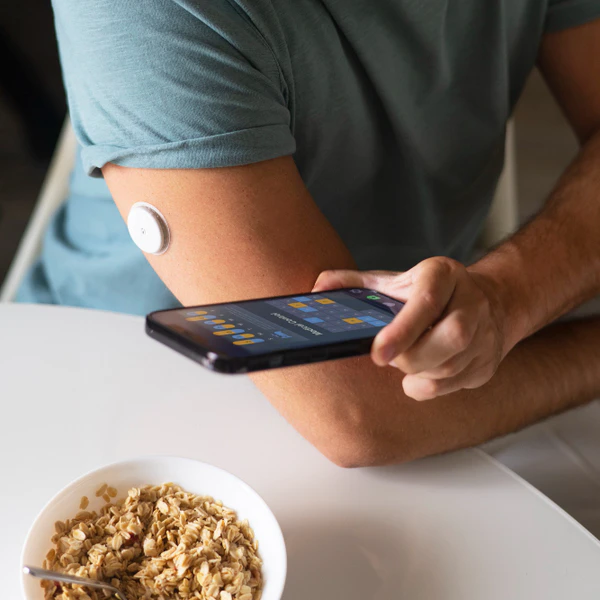
A continuous glucose monitor, or CGM, is a small sensor worn on the skin. It checks glucose in the fluid under the skin every few minutes and sends those readings to a phone or reader.
Continuous glucose monitors can help you spot high blood sugar spikes after meals so you can adjust carbs and meal timing for better metabolic health.
That kind of steady stream feels very different from a single lab test. A lab test shows one point in time. A CGM shows rise, fall, speed, and timing across the day.
A device that turns an unseen body process into a moving graph can feel useful, even before a person knows what to do with every number (Klonoff et al., 2023).
Normal Readings
Part of the interest comes from seeing what is normal in people without diabetes. In one multicenter study of healthy participants, median time between 70 and 140 mg/dL was 96%, with only brief time above or below those ranges (Shah et al., 2019).
That type of data gives healthy users a frame of reference. It also shows why many short rises after meals are not always a sign of disease.
A CGM can still feel eye opening, though. A person may eat the same breakfast on two days and see two different curves because sleep, stress, movement and meal timing can all shift the result (Johns Hopkins Bloomberg School of Public Health, 2026).
Why Interest Grew
Easier Access
A major reason for the rise in public interest is simple access. Once a tool moves from specialist care toward easier retail purchase, more people start to view it as a wellness device and not only a medical one (Johns Hopkins Bloomberg School of Public Health, 2026).
The user is no longer only a person dosing insulin. The user may also be a runner, a person trying to lose weight, or someone who wants more data on daily habits.
As access widens, the language around the device shifts too. Instead of disease control, the pitch often centers on insight, optimization and prevention. That kind of framing reaches a much larger group (Klonoff et al., 2023).
Wellness Appeal
Watches track sleep. Rings track recovery. CGMs add a live feed tied to food and movement, which makes them feel more direct and personal than many other health metrics.
That is a strong draw for people who like experiments. A person can wear a sensor, eat lunch, walk for ten minutes, and then watch the line change on the screen.
A 2024 systematic review and meta-analysis found that CGM-based feedback had favorable, though modest, effects on glucose related outcomes, while also noting that more work is needed to explain how behavior changes happen and who gains most (Richardson et al., 2024).
Performance Curiosity
Some healthy adults also use CGMs for sport and training. The idea is that better timing of meals, training, and recovery may support steadier energy through the day.
A review on non-diabetic use identified health and wellness as well as elite athletics as key use cases now driving interest (Klonoff et al., 2023).
The rise in popularity makes sense when a device seems to offer a tight link between action and result. People tend to like tools that make cause and effect feel visible.
Sugar Creates Problems Fast
There are zero essential carbohydrates. Your body can make what it needs.
What People Hope To Learn
Meal Response
Many healthy users want to know which foods send glucose higher and which meals feel steadier.
The glucose curve after eating does vary from meal to meal and from person to person (Jarvis et al., 2023).
The risk is reading too much into every rise. A short post meal increase can be a normal response to fuel coming into the body.
A CGM can show the rise, but it cannot alone say whether a person is sick, healthy, or headed toward disease (Shah et al., 2019).
Movement Effects
Another strong reason for growing use is that exercise often changes the graph in a way people can see right away.
In healthy adults, both structured activity and light post meal movement can improve post meal glucose readings, which helps explain why users find CGMs motivating for daily walks and exercise timing (Babir et al., 2023; Solomon et al., 2020).
A person can see a walk change the line on the screen within a short time, and that can reinforce the habit.
Habit Tracking
CGMs also attract people who want to connect glucose with sleep, stress, late meals or long gaps without food. The device can make those daily choices feel less abstract.
For some, that may lead to better routines. For others, it may lead to too much checking, too much worry, and too many food rules based on small swings that may not have real health meaning (Johns Hopkins Bloomberg School of Public Health, 2026).
Better vs Worse
| Better | Worse |
|---|---|
| Protein first meals | Soda |
| Walking after food | Juice |
| No sweet drinks | Snacks |
| Good sleep | Sugar |
Caution Needed
Clear Benefit Gaps
Proof of long term benefit in healthy people is still thin. Experts interviewed by Johns Hopkins noted that the evidence is scant and that major clinical trials have not shown that changing CGM readings in healthy people leads to better health (Johns Hopkins Bloomberg School of Public Health, 2026).
A CGM may help someone notice a habit. That is different from proving fewer cases of diabetes, less heart disease, or lasting weight loss.
Accuracy Limits
The readings also need care in how they are read. CGMs do not measure blood glucose directly. They measure glucose in fluid under the skin, and that can lag behind blood levels.
Newer work has also found bias in healthy users. In a 2025 randomized crossover trial, CGMs overestimated glycemia, and the size of that bias changed by test food and by person (Hutchins et al., 2025).
Earlier work found that different CGMs could even rank the same meals differently in people without diabetes, which raises a real concern for anyone trying to build strict food rules from one device readout (Howard et al., 2020).
Cost & Stress
A final reason to slow down is that a healthy person may spend a fair amount of money for data that creates more stress than clarity.
Short spikes can look dramatic on an app, even when they fall inside a normal range for everyday life.
That can drive needless fear of normal body responses. A healthy person may start chasing a flat line that the body was never meant to hold all day.
The best case is not perfect glucose. The best case is better judgment about what the device can and cannot say.
Blood Sugar Check
Who May Find Value
Best Fit
The people most likely to get useful insight are often those with a clear question. Someone may want to test how late meals affect sleep, whether a short walk after lunch changes the curve, or how often a certain breakfast leads to a sharp rise.
A limited trial with one clear goal may be more useful than open ended tracking with no plan. The data tends to be easier to read when the question is narrow.
A person with prediabetes, obesity, a strong family history of diabetes, or repeated abnormal lab results may also have more reason to discuss CGM use with a clinician, since the device could sit beside other clinical data rather than replace it (Klonoff et al., 2023).
Consult a licensed healthcare professional before starting, stopping, or changing any diet, supplement, medication, or wellness practice. For questions about a medical condition or symptoms, seek advice from a qualified clinician who can assess your situation.
Suggested Posts


Research
Klonoff, D.C., Nichols, K.T. and Xu, N.Y. (2023) ‘Use of Continuous Glucose Monitors by People Without Diabetes: An Idea Whose Time Has Come?’, Journal of Diabetes Science and Technology, 17(6), pp. 1686–1697. Available at: https://pubmed.ncbi.nlm.nih.gov/35856435/
Shah, V.N., Joshee, P., Sippl, R., Pyle, L., Vigers, T., Carpenter, R.D., Kohrt, W. and Snell-Bergeon, J.K. (2019) ‘Continuous Glucose Monitoring Profiles in Healthy Nondiabetic Participants: A Multicenter Prospective Study’, Journal of Clinical Endocrinology and Metabolism, 104(10), pp. 4356–4364. Available at: https://pubmed.ncbi.nlm.nih.gov/31127824/
Johns Hopkins Bloomberg School of Public Health (2026) ‘Are Glucose Monitors Useful for People Who Don’t Have Diabetes?’, 28 January. Available at: https://publichealth.jhu.edu/2026/is-glucose-monitoring-useful-for-non-diabetics
Richardson, K.M., Jospe, M.R., Bohlen, L.C., Crawshaw, J., Saleh, A.A. and Schembre, S.M. (2024) ‘The efficacy of using continuous glucose monitoring as a behaviour change tool in populations with and without diabetes: a systematic review and meta-analysis of randomised controlled trials’, International Journal of Behavioral Nutrition and Physical Activity, 21(1), 145. Available at: https://pubmed.ncbi.nlm.nih.gov/39716288/
Jarvis, P.R.E., et al. (2023) ‘Continuous glucose monitoring in a healthy population: understanding the post-prandial glycemic response in individuals without diabetes mellitus’, Metabolism, 146, 155640. Available at: https://pubmed.ncbi.nlm.nih.gov/37356796/
Babir, F.J., et al. (2023) ‘The effect of bodyweight exercise on 24-h glycemic responses determined by continuous glucose monitoring in healthy inactive adults: a randomized crossover study’, Scientific Reports, 13(1), 20884. Available at: https://pubmed.ncbi.nlm.nih.gov/38017140/
Solomon, T.P.J., et al. (2020) ‘Immediate post-breakfast physical activity improves interstitial postprandial glycemia: a comparison of different activity-meal timings’, Pflügers Archiv – European Journal of Physiology, 472(2), pp. 271–280. Available at: https://pubmed.ncbi.nlm.nih.gov/31396757/
Hutchins, K.M., et al. (2025) ‘Continuous glucose monitor overestimates glycemia, with the magnitude of bias varying by postprandial test and individual – a randomized crossover trial’, American Journal of Clinical Nutrition, 121(5), pp. 1025–1034. Available at: https://pubmed.ncbi.nlm.nih.gov/40021059/
Howard, R., et al. (2020) ‘Imprecision nutrition? Different simultaneous continuous glucose monitors provide discordant meal rankings for incremental postprandial glucose in subjects without diabetes’, American Journal of Clinical Nutrition, 112(4), pp. 1114–1119. Available at: https://pubmed.ncbi.nlm.nih.gov/32766882/
Ahmed, N. et al. (2025) ‘Use of Continuous Glucose Monitoring in Non-diabetic Individuals for Cardiovascular Prevention: A Systematic Review of Its Impact on Guiding Lifestyle Interventions’, Cureus, 17(10), e94460. doi: 10.7759/cureus.94460.
Hjort, A. et al. (2024) ‘Glycemic variability assessed using continuous glucose monitoring in individuals without diabetes and associations with cardiometabolic risk markers: A systematic review and meta-analysis’, Clinical Nutrition, 43(4), pp. 915–925. doi: 10.1016/j.clnu.2024.02.014.
Barua, S. et al. (2022) ‘Discordance between postprandial plasma glucose measurement and continuous glucose monitoring’, American Journal of Clinical Nutrition, 116(4), pp. 1059–1069. doi: 10.1093/ajcn/nqac181.
DuBose, S.N. et al. (2021) ‘Effect of Exercise and Meals on Continuous Glucose Monitor Data in Healthy Individuals Without Diabetes’, Journal of Diabetes Science and Technology, 15(3), pp. 593–599. doi: 10.1177/1932296820905904.
Freckmann, G. et al. (2024) ‘Continuous Glucose Profiles in Healthy People With Fixed Meal Times and Under Everyday Life Conditions’, Journal of Diabetes Science and Technology, 18(2), pp. 407–413. doi: 10.1177/19322968221113341.
Dimitropoulou, N.M. et al. (2025) ‘Glucose variability measured by continuous glucose monitoring is associated with skin autofluorescence: the Maastricht Study’, Diabetologia, 68(9), pp. 1937–1946. doi: 10.1007/s00125-025-06469-5.
Köhlmoos, A. et al. (2025) ‘Glycemic Variability and Control by CGM in Healthy Older and Young Adults and Their Relationship With Diet’, Journal of the Endocrine Society, 9(7), bvaf081. doi: 10.1210/jendso/bvaf081.
González-Rodríguez, M. et al. (2019) ‘Postprandial glycemic response in a non-diabetic adult population: the effect of nutrients is different between men and women’, Nutrition and Metabolism, 16, 46. doi: 10.1186/s12986-019-0368-1.
Zhou, J. et al. (2011) ‘Establishment of normal reference ranges for glycemic variability in Chinese subjects using continuous glucose monitoring’, Medical Science Monitor, 17(1), pp. CR9–CR13. doi: 10.12659/msm.881318.
Derosa, G. et al. (2009) ‘Continuous glucose monitoring system in free-living healthy subjects: results from a pilot study’, Diabetes Technology and Therapeutics, 11(3), pp. 159–169. doi: 10.1089/dia.2008.0101.
Holzer, R. et al. (2022) ‘Continuous Glucose Monitoring in Healthy Adults-Possible Applications in Health Care, Wellness, and Sports’, Sensors, 22(5), 2030. doi: 10.3390/s22052030.