Key Takeaways
- Eczema often starts with a weak skin barrier and an overactive immune response.
- Common symptoms include itching, dry patches, redness, cracks and rough skin.
- Flares can follow heat, sweat, harsh soap, fragrance, stress and dry air.
- Natural care should protect the skin barrier and reduce daily irritation.
- Severe itching, infection signs or sleep loss need proper care from a clinician.
Symptoms
Itch & Dry Skin
Eczema is a common skin condition that often causes dry, itchy and inflamed skin. Atopic dermatitis is the most common type.
It often begins in childhood, but adults can have it too. The skin may look red, brown, purple or gray depending on skin tone.
Itching is often the hardest symptom. The skin can itch before a rash looks obvious.
Scratching then damages the outer skin and makes the area more irritated. The itch and scratch cycle can keep the skin active for weeks.
Eczema can affect sleep when itching gets worse at night. Poor sleep then makes stress harder to handle, which can make the next flare feel worse.
A review in American Family Physician describes eczema as a relapsing condition with itching, dry skin and inflamed patches as core features (1).
Patches & Cracks
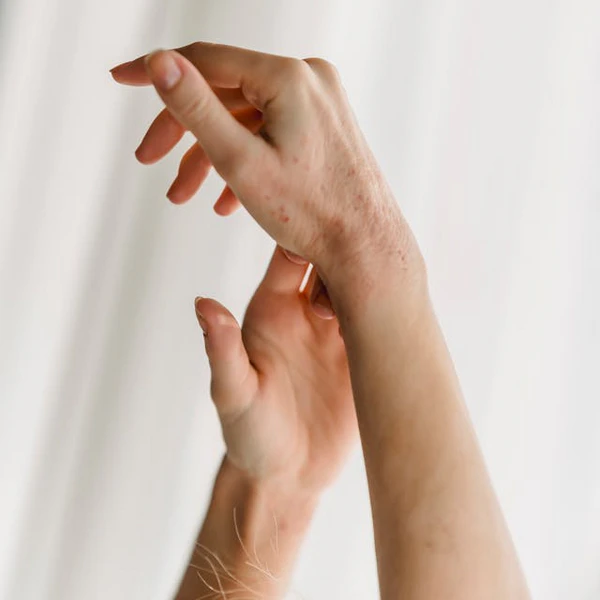
Eczema patches can appear on the face, hands, neck, elbows, knees and ankles. Babies often get it on the cheeks and scalp.
Older children and adults often get it in skin folds, on the hands or around the eyes.
Dry eczema can crack and sting. The skin may look thick after repeated scratching. Some areas can ooze when the skin is very inflamed or infected.
Hand eczema is common because the hands touch water, soap and cleaning products often.
Frequent washing can remove natural oils from the skin. Gloves can help during wet work, but sweaty gloves can also bother some people.
Infection Signs
Broken eczema skin can become infected. Warning signs include more pain, warmth, swelling, pus, yellow crust or fast spreading redness. Fever or feeling unwell needs urgent medical care.
Eczema can also look like other skin problems. Fungal infection, psoriasis and contact allergy can be mistaken for eczema. Proper diagnosis helps avoid the wrong care.
Joint pain, severe swelling or painful widespread rash should not be treated as normal dry skin.
Eczema is common, but every rash is not eczema. A trained clinician can check the skin and guide care when the picture is unclear.
Causes
Skin Barrier
Eczema often starts with a weak outer skin barrier. The barrier should hold water in and keep irritants out. When it is weak, the skin loses water faster and reacts more easily to daily contact.
Filaggrin is one barrier protein linked with eczema risk. A major genetics study found that loss of function variants in the filaggrin gene strongly increased risk for atopic dermatitis (2).
A weak barrier does not mean poor hygiene. Over washing can make eczema worse because it removes skin oils and raises water loss. The skin usually needs less irritation and more protection.
Immune Response
Eczema also involves the immune system. The skin can react too strongly to normal triggers. This can create redness, itching and swelling.
The Lancet review describes atopic dermatitis as a disease involving barrier problems, immune changes, itch pathways and environmental triggers (3).
The skin microbiome can also change. Staphylococcus aureus is more common on eczema skin, especially during flares.
A review on the skin and gut microbiome in atopic dermatitis describes lower skin microbe diversity and more Staphylococcus overgrowth during active disease (4).
Daily Triggers
Eczema triggers are different from person to person. Common triggers include heat, sweat and dry air. Soap, fragrance and cleaning products can also irritate the skin.
Stress can make itching worse. The skin and nervous system talk through immune signals and itch nerves. A stressful week may show up as more scratching, worse sleep and stronger flares.
Food can trigger eczema in some children, but food is not the cause for every case. Broad food restriction can create new problems when it is done without a clear reason.
Food testing should be careful and guided when reactions are strong or children are involved.
Natural Treatment
Gentle Washing
Eczema skin needs gentle washing. Use warm water instead of hot water. Hot water can strip the skin and increase dryness after the bath or shower.
Use a mild cleanser only where needed. The armpits, groin and feet usually need more cleaning than dry arms or legs. Fragrance free products are often safer for reactive skin.
Bathing should end with moisture. Pat the skin gently and apply a plain moisturizer while the skin is still damp. This helps hold water in the outer skin.
Moisturizers
Moisturizers are one of the most important parts of eczema care. They help reduce dryness, protect the barrier and lower water loss from the skin.
A review on moisturizers in dermatitis describes their use for improving barrier function and reducing symptoms such as dryness and itching (5).
Thick creams and ointments usually protect better than thin lotions. Lotions can sting when the skin is cracked because they contain more water and added ingredients. A plain cream is often easier to tolerate.
Use moisturizer more often during flares. Hands may need it after each wash. Dry legs may need it after bathing and again before bed. The product should feel calm on the skin.
Irritant Control
Remove the irritants that touch the skin often. Use fragrance free laundry detergent. Skip scented dryer sheets. Keep perfume, scented oils and strong soaps away from active eczema.
Clothing should feel soft against the skin. Rough wool can make itching worse. Loose cotton layers often feel easier during a flare.
Keep nails short to reduce damage from scratching. Use a cool cloth when itching gets intense. Covering the area with soft clothing can reduce direct scratching during sleep.
Daily Support
Sleep, stress and sweating can change eczema symptoms. A steady sleep routine can reduce the strain that makes itching harder to handle.
Morning light and a darker room at night can support better sleep timing.
Nutrition should support skin repair without turning the whole article into a food list.
A traditional meal based on ruminant meat with enough animal fat gives protein, minerals and stable fuel without a sugar load.
Seed oils, fortified grains and sweet snacks are poor choices when the skin is already inflamed.
Natural care has limits. Severe eczema can damage sleep, mood and daily life.
A review of treatment options notes that eczema care often needs barrier repair, trigger control and medical assessment when disease is moderate or severe (6).
Care Boundaries
Children
Children with eczema need gentle care because their skin can flare quickly. Scratching can become intense at night. Parents may notice poor sleep before they notice the full rash.
Emollients are a core part of child eczema care. NICE guidance for children under twelve emphasizes regular emollient use, enough supply and clear instructions for families (7).
Children with infected eczema, poor growth, severe sleep loss or suspected food reactions need proper assessment. Food restriction in children should never be casual because growth depends on enough nutrients.
When To Get Help
Get help when eczema spreads fast, cracks deeply or shows infection signs. Yellow crust, pus, heat, swelling and increasing pain need attention.
Eye area eczema also deserves care because the skin is thin and sensitive.
Regular flares that interrupt sleep need more than trial and error. Sleep loss can harm mood, learning, work and family life.
A clinician can confirm the diagnosis and check for allergy, infection or another skin disease.
Home care works best when it protects the barrier every day. Gentle washing, plain moisturizer, soft clothing and fewer irritants can lower the daily burden on the skin. The routine should be calm enough to repeat without making life revolve around the rash.
For any health concerns or questions about a medical condition, get guidance from a physician or another appropriately trained clinician. Before changing your diet, supplements, or health routine, talk with a licensed healthcare professional.
Suggested Posts
Research
Jeskey, J., Rulla, C., Dohil, M., Avila, A. and Eichenfield, L.F. 2024. Atopic dermatitis. A review of diagnosis and treatment. American Family Physician, 110, pp.353 to 361. PMID 39408667.
Palmer, C.N.A. et al. 2006. Common loss of function variants of the epidermal barrier protein filaggrin are a major predisposing factor for atopic dermatitis. Nature Genetics, 38, pp.441 to 446. DOI 10.1038/ng1767. PMID 17291859.
Langan, S.M., Irvine, A.D. and Weidinger, S. 2020. Atopic dermatitis. Lancet, 396, pp.345 to 360. DOI 10.1016/S0140-6736(20)31286-1. PMID 32738956.
Kim, J.E. and Kim, H.S. 2022. Microbiome of the skin and gut in atopic dermatitis. Allergy, Asthma & Immunology Research, 14, pp.453 to 467. DOI 10.4168/aair.2022.14.5.453. PMID 36062630.
Purnamawati, S., Indrastuti, N., Danarti, R. and Saefudin, T. 2017. The role of moisturizers in addressing various kinds of dermatitis. A review. Clinical Medicine & Research, 15, pp.75 to 87. DOI 10.3121/cmr.2017.1363. PMID 28592455.
Lee, J.H., Son, S.W. and Cho, S.H. 2016. A comprehensive review of the treatment of atopic eczema. Allergy, Asthma & Immunology Research, 8, pp.181 to 190. DOI 10.4168/aair.2016.8.3.181. PMID 26922927.
National Institute for Health and Care Excellence. 2013. Quality statement 4. Provision of emollients. Atopic eczema in under 12s. NICE.
Thyssen, J.P., Kezic, S. and Jakasa, I. 2020. Skin barrier dysfunction in atopic dermatitis. Causes and consequences. Journal of Allergy and Clinical Immunology, 145, pp.1010 to 1012.
Nutten, S. 2015. Atopic dermatitis. Global epidemiology and risk factors. Annals of Nutrition and Metabolism, 66, pp.8 to 16. DOI 10.1159/000370220. PMID 25925336.
Goddard, A.L. and Lio, P.A. 2015. Alternative, complementary, and forgotten remedies for atopic dermatitis. Evidence Based Complementary and Alternative Medicine, 2015, 676897. DOI 10.1155/2015/676897. PMID 26246876.
Sroka Todorovic, J. et al. 2025. Topical emollients to prevent atopic dermatitis in pediatric patients. A systematic review and individual participant data meta analysis. JAMA Dermatology, 161, pp.729 to 738. DOI 10.1001/jamadermatol.2025.0896. PMID 40582042.
Chai, H. and Wang, X. 2025. Understanding atopic dermatitis. Pathophysiology and treatment. International Journal of Molecular Sciences, 26, 9708.
Nemeth, V., Evans, J. and Knable, A.L. 2024. Eczema. StatPearls. PMID 30860795.
David Boothe, W., Tarbox, J.A. and Tarbox, M.B. 2026. Atopic dermatitis. StatPearls. PMID 28846349.
Mayo Clinic. 2024. Atopic dermatitis eczema. Symptoms and causes. Mayo Clinic.
Royal Children’s Hospital Melbourne. 2024. Clinical practice guidelines. Eczema. RCH.
National Eczema Association. 2026. Atopic dermatitis. National Eczema Association.
American Academy of Pediatrics. 2026. Treatment of atopic dermatitis. AAP.
Primary Care Dermatology Society. 2025. Atopic eczema. PCDS.
American Academy of Dermatology. 2026. Eczema types. Atopic dermatitis diagnosis and treatment. AAD.