Key Takeaways
- Psoriasis causes thick, inflamed skin because new skin cells form much faster than normal.
- Common signs include raised patches, dry scales and skin that may itch or crack.
- Genes affect your risk, while infections, stress and skin injuries can trigger flares.
- Excess body fat, poor metabolic health and smoking are linked with more severe psoriasis.
- Sunlight, weight loss and trigger control may reduce symptoms for some people with psoriasis.
Psoriasis Symptoms
Skin Changes
Psoriasis causes skin cells to grow much faster than normal. The extra cells collect on the skin instead of shedding slowly.
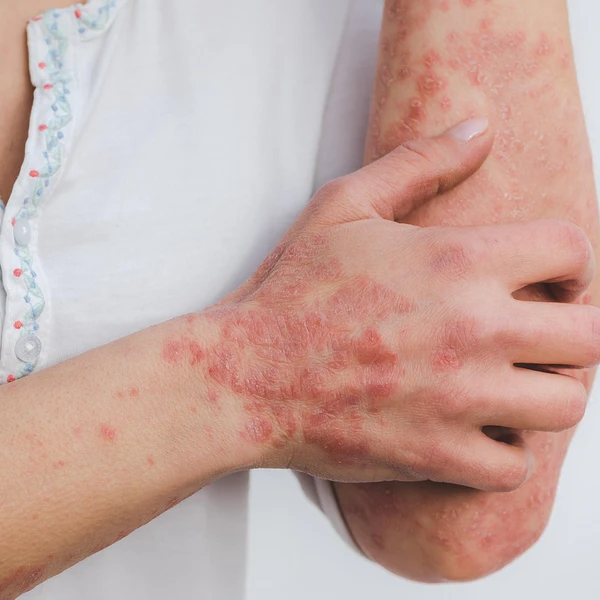
Plaque psoriasis is the most common type. It causes raised patches covered with dry scales. The patches often appear on the scalp, knees or elbows.
Your skin may itch, burn or feel sore. Deep cracks can bleed. Some patches feel tight when you bend a joint.
Symptoms can clear for a while and return later. A flare may last several weeks or months. Some people have mild patches while others have large areas of inflamed skin. (1)
Nails & Joints
Psoriasis can affect your fingernails or toenails. Small dents may form across the nail. The nail may become thick or separate from the skin below it.
Joint pain needs attention because psoriasis can occur with psoriatic arthritis. You may notice swelling, stiffness or pain around a joint.
Early joint damage may become permanent. New joint pain should not be dismissed as a minor part of the skin problem.
Different Forms
Guttate psoriasis causes many small spots across the skin. It often starts after a throat infection, especially in children or young adults.
Inverse psoriasis causes smooth red patches in skin folds. Heat and rubbing can make it worse.
Pustular psoriasis causes pus filled bumps surrounded by red skin. Erythrodermic psoriasis causes widespread redness and heavy shedding. Both forms can become serious and need prompt medical care.
Psoriasis Causes
Immune Activity
Psoriasis begins when immune cells become too active. They release signals that speed up skin growth and keep the skin inflamed.
Normal skin cells take weeks to reach the surface. Psoriasis cuts that time sharply. The cells collect before older skin can shed.
Several immune signals are involved, including tumour necrosis factor and interleukin 17. These signals help explain why psoriasis can affect more than your skin. (2)
Psoriasis has no single cause. Your genes can raise the chance of developing it. Outside triggers may then start the first outbreak or bring back an old flare.
Common Triggers
Infections can trigger psoriasis. Strep throat has a strong link with guttate psoriasis.
Skin damage can cause a new patch where the injury occurred. Cuts, burns or heavy scratching may cause this response.
Stress can make flares more likely or harder to control. Smoking is also linked with psoriasis and may worsen severe disease.
Some medicines can trigger or worsen symptoms. Do not stop a prescribed medicine suddenly. Ask the person who prescribed it to review the timing and your skin changes.
Body Weight & Metabolism
Psoriasis occurs more often in people with obesity. More severe psoriasis has an even stronger link with excess body fat.
A large review covered 16 studies with more than two million people. People with psoriasis had higher odds of obesity than people without psoriasis. The link was strongest among those with severe psoriasis. (3)
Body fat releases immune signals that can add to inflammation. High insulin and poor blood sugar control may add more strain.
Psoriasis is also linked with metabolic syndrome. Blood pressure, blood sugar and triglycerides deserve attention when psoriasis keeps returning. (4)
Association does not prove that body fat caused the skin disease. Psoriasis can also make movement harder and reduce the desire to exercise in public.
Dry Skin Can React To Harsh Products
Dry skin often gets worse when soaps, acids or fragrance strip the skin barrier.
Natural Treatment
Sunlight
Sunlight can slow the fast growth of skin cells. Many people notice that controlled sun exposure reduces their patches.
Start with a short period and avoid burning. A burn can injure the skin and trigger another flare.
The amount of sunlight you can handle depends on your skin colour and the strength of the sun. Your location also changes how quickly your skin burns.
Medical ultraviolet light uses measured doses under supervision. Ordinary sunlight is harder to measure, so increase exposure slowly. Research supports ultraviolet B light as an established treatment for psoriasis. (5)
Sunlight also helps set your body clock. Morning light may improve sleep, which can make stress easier to handle. (6)
Weight Loss
Weight loss can reduce psoriasis severity in people carrying excess body fat. The effect will vary because psoriasis has several causes.
A randomised study found that people who lost weight had a larger drop in psoriasis severity than the control group. The study included people with psoriasis who were overweight. (7)
Cut sugar and refined starch first. These foods drive hunger and make blood sugar harder to control.
Choose meat, eggs or seafood as your main food. Natural animal fat can help you feel full without a large rise in blood sugar.
Grains add starch and often contain fortified iron. Packaged foods may also contain seed oils that oxidise easily.
Weight loss should remain gradual. Severe food restriction can raise stress and make the plan hard to maintain.
Food Triggers
No single food causes every case of psoriasis. Some people notice clear reactions after certain foods while others see no change.
Keep a short record of food and skin changes. Track one change at a time. A long list of changes makes the result impossible to judge.
Alcohol can worsen psoriasis in some people. It can also harm sleep and liver health.
Gluten removal may help people who have coeliac disease or clear gluten sensitivity. Evidence does not support removing gluten from every person with psoriasis.
Research on special psoriasis diets remains uneven. Many studies are small or rely on food reports. Strong claims about one food curing psoriasis go beyond the evidence. (8)
Skin Care
Use warm water instead of very hot water. Hot water can dry the skin and increase itching.
Apply a plain animal fat after bathing while the skin is still damp. Tallow can reduce water loss and soften dry scales.
Avoid scented skin products when they cause burning or redness. Fragrance can irritate damaged skin.
Do not pull thick scales from the skin. Forced removal can cause bleeding and trigger a new patch.
Short nails can reduce damage from scratching. Cool cloths may calm a hot or itchy area.
Sleep & Stress
Poor sleep can increase pain and make itching harder to ignore. It can also make stress feel stronger the next day.
Keep the same waking time each day. Get outside light early. Make the bedroom dark at night.
Stress does not mean psoriasis comes from your thoughts. Stress changes immune activity and can trigger a flare in someone who already has the condition.
Use any calm activity you can repeat each day. Walking, slow breathing or quiet time can help. Choose one method instead of forcing a long routine.
Use vs Avoid
| Use | Avoid |
|---|---|
| Gentle cleanser | Harsh soap |
| Plain moisturizer | Fragrance |
| Short warm shower | Over exfoliating |
| Fragrance free products | Hot long showers |
Minerals & Psoriasis
Mineral Testing
Minerals help control skin growth and immune activity. A poor diet can leave gaps, especially when someone avoids many foods.
Magnesium supports hundreds of body reactions. Copper helps control iron and oxidative stress. Selenium supports several antioxidant enzymes.
A mineral problem cannot be diagnosed from psoriasis alone. Testing should match your symptoms and food choices.
Useful tests may include magnesium, copper or ceruloplasmin. A full iron panel can also help when fatigue is present.
Ferritin can rise during inflammation. A high result does not always mean iron is being handled well.
Supplement Caution
Synthetic zinc is often promoted for skin problems. High doses can lower copper and create a second problem.
Synthetic iron should not be used because you feel tired. Poor sleep and inflammation can cause the same symptom.
Synthetic vitamin D has not shown a clear overall benefit for psoriasis in clinical trials. Blood levels also do not show the full effect of sunlight on the skin.
Food provides nutrients with less risk of pushing one mineral far above another. Liver supplies copper and retinol in a concentrated form. Small servings are enough.
Psoriasis can improve for long periods and still return. Keep track of clear triggers and changes that genuinely help.
For any health concerns or questions about a medical condition, get guidance from a physician or another appropriately trained clinician. Before changing your diet, supplements, or health routine, talk with a licensed healthcare professional.
Suggested Posts
Evidence Limits
Research
National Institute of Arthritis and Musculoskeletal and Skin Diseases. 2023. Psoriasis. National Institutes of Health.
Rendon, A. and Schäkel, K. 2019. Psoriasis pathogenesis and treatment. International Journal of Molecular Sciences, 20, 1475.
Singh, S., Young, P. and Armstrong, A.W. 2017. An update on psoriasis and metabolic syndrome. Dermatology Practical and Conceptual, 7, pp. 1 to 8.
Armstrong, A.W., Harskamp, C.T. and Armstrong, E.J. 2012. The association between psoriasis and obesity. A systematic review and meta analysis of observational studies. Nutrition and Diabetes, 2, e54.
McCullough, P.J. and Lehrer, D.S. 2021. Oral and topical vitamin D, sunshine and UVB phototherapy. A review. International Journal of Environmental Research and Public Health, 18, 6365.
Blume, C., Garbazza, C. and Spitschan, M. 2019. Effects of light on human circadian rhythms, sleep and mood. Somnologie, 23, pp. 147 to 156.
Jensen, P. et al. 2013. Effect of weight loss on the severity of psoriasis. A randomized clinical study. JAMA Dermatology, 149, pp. 795 to 801. PMID 24126575.
Yeroushalmi, S. et al. 2022. The gut microbiome and psoriasis. A review. Dermatology and Therapy, 12, pp. 111 to 123.
Griffiths, C.E.M. et al. 2021. Psoriasis. Lancet, 397, pp. 1301 to 1315.
Kamiya, K. et al. 2019. Risk factors for the development of psoriasis. International Journal of Molecular Sciences, 20, 4347.
Kaushik, S.B. and Lebwohl, M.G. 2019. Psoriasis. Which therapy for which patient. Psoriasis comorbidities and preferred systemic agents. Journal of the American Academy of Dermatology, 80, pp. 27 to 40.
Dai, Q. et al. 2023. Efficacy and safety of vitamin D supplementation on psoriasis. A systematic review and meta analysis. PLOS ONE, 18, e0294239.
Ko, S.H. et al. 2014. Nutrition and psoriasis. A systematic review. Journal of the American Academy of Dermatology, 71, pp. 561 to 569.
Ford, A.R. et al. 2018. Dietary recommendations for adults with psoriasis or psoriatic arthritis from the Medical Board of the National Psoriasis Foundation. A systematic review. JAMA Dermatology, 154, pp. 934 to 950.
Wolk, K., Sabat, R. and Philippe, B. 2009. Pathogenesis and treatment of psoriasis. Journal of Molecular Medicine, 87, pp. 357 to 368.
Boehncke, W.H. and Schön, M.P. 2015. Psoriasis. Lancet, 386, pp. 983 to 994.
Hugh, J.M. et al. 2014. From the Medical Board of the National Psoriasis Foundation. The risk of cardiovascular disease in individuals with psoriasis and the potential impact of current therapies. Journal of the American Academy of Dermatology, 70, pp. 168 to 177.
Takeshita, J. et al. 2017. Psoriasis and comorbid diseases. Epidemiology. Journal of the American Academy of Dermatology, 76, pp. 377 to 390.