Key Takeaways
- Elderberry may ease cold symptoms for some people, but studies have not shown reliable prevention of colds.
- An early flu trial found faster recovery with elderberry, while a later trial found no benefit.
- Raw elderberries and parts of the plant can cause poisoning, so only properly prepared products should be consumed.
- Different syrups and capsules may contain different ingredients, making products difficult to compare with clinical trials.
- Flu can become dangerous quickly, and anyone at high risk should seek medical care without delay.
Elderberry is used in syrups, capsules and other products sold for colds and flu. Some human studies found that people taking elderberry recovered sooner or had milder symptoms. Other studies found no clear benefit.
The berries also contain substances that can make you sick if they are eaten raw or prepared incorrectly. This is especially important for anyone making elderberry syrup at home.
Researchers have tested several elderberry products in people with respiratory infections. Their results help explain which benefits are possible, what remains uncertain and which safety warnings deserve attention.
Elderberry & Viruses
Black Elderberry
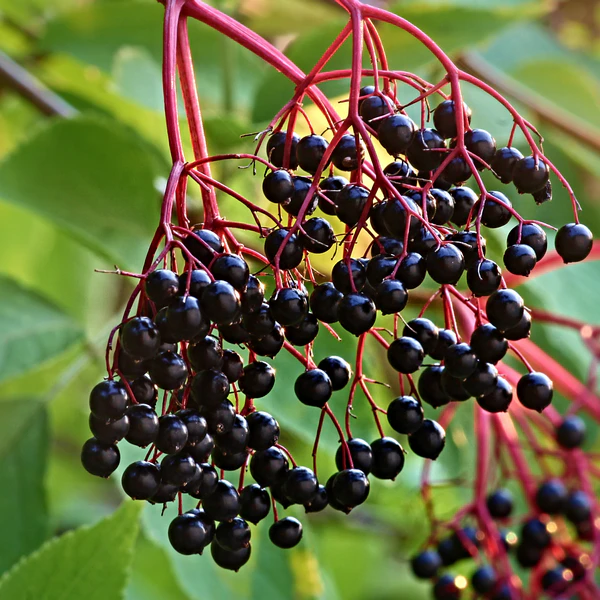
Most elderberry supplements contain extracts from Sambucus nigra, also called black elderberry. The plant produces clusters of small, dark berries that have been used in traditional preparations for generations.
The berries contain natural pigments called anthocyanins, which give them their dark purple colour. They also contain other substances that researchers have examined for possible effects on viruses and the immune system.
Some of these substances can affect viruses in laboratory experiments. Researchers have also found that elderberry extracts can change how certain immune cells behave.
However, there is a difference between what happens when scientists put a plant extract directly onto a virus and what happens after someone swallows it. The body digests the extract and changes many of its ingredients before they reach other tissues.
Effects On Flu Viruses
In 2009, researchers tested elderberry extract against the H1N1 influenza virus in a laboratory. They found that some substances in the extract attached to the virus and stopped it from infecting cells.
These experiments help explain how elderberry might affect influenza. However, the researchers did not give the extract to people with flu or measure whether it helped anyone recover.
The amounts used in laboratory experiments also cannot tell us how much elderberry someone would need to swallow to produce the same effect inside the body. (1)
Cold & Flu Studies
Colds During Travel
A 2016 trial followed 312 people travelling from Australia to another country. Half received elderberry capsules, while the others received capsules without elderberry.
The participants started taking the capsules before their flights and continued for several days after arriving at their destinations.
Twenty nine people developed a cold during the study. Twelve were taking elderberry, while seventeen were taking the placebo.
The difference was too small to show that elderberry prevented people from catching colds.
However, those who developed a cold while taking elderberry reported being sick for about 4.8 days. People taking the placebo reported an average of 6.9 days.
The people taking elderberry also reported less severe symptoms.
Only 29 participants developed colds, so the results came from a relatively small group. The study was also funded by a company that supplied the elderberry extract. (2)
Early Flu Research
A study published in 2004 tested elderberry syrup in sixty people with influenza A or B.
Half received an elderberry extract, while the other half received a placebo. Participants started treatment within two days of developing symptoms and continued for five days.
People taking elderberry reported feeling better after three to four days. Those taking the placebo generally needed seven to eight days.
The participants taking elderberry also used fewer other medicines to relieve their symptoms.
These results were encouraging, but the study involved only sixty people. A larger trial was needed to find out whether the improvement would happen consistently. (3)
A Later Flu Trial
In 2020, researchers published a trial involving 87 people who had tested positive for influenza. The participants were at least five years old and had been sick for less than two days.
Forty three received elderberry extract, while forty four received a placebo. They took their assigned treatment for five days.
The researchers checked how long it took for the participants’ symptoms to become mild and how long it took for them to disappear completely.
People taking elderberry needed an average of 5.3 days for their symptoms to become mild. Those taking the placebo needed 4.9 days.
Complete recovery took approximately 8.6 days with elderberry and 8.7 days with the placebo.
The researchers found no meaningful improvement in recovery time or symptom severity. Some participants also took prescription flu treatment during the trial. (4)
The results differed considerably from the earlier flu study. Both experiments involved relatively small groups, so neither can settle the question on its own.
Combined Research
In 2021, researchers reviewed five controlled trials that had tested elderberry for preventing or treating respiratory infections.
They found that elderberry might shorten colds and reduce some symptoms. There was also some evidence that it could shorten flu.
However, the studies involved small groups and used different products. Some results were very different between trials, making it difficult to know how much benefit people could expect.
The researchers also found no convincing evidence that elderberry prevents people from catching a cold.
They examined concerns about elderberry causing excessive immune reactions but found no human studies showing that it caused serious problems of that kind. They also could not rule out uncommon or long term side effects. (5)
Safety & Poisoning
Raw Elderberries
Raw or unripe elderberries contain substances that can release cyanide when the body breaks them down. The leaves and stems also contain these substances and should never be used in drinks or homemade remedies.
Eating these parts of the plant can cause nausea, vomiting and diarrhoea. Large amounts can cause more serious poisoning.
In August 1983, several people became ill after drinking homemade elderberry juice at a gathering in California.
The juice had been prepared from freshly picked berries, and the plant material had been crushed during preparation.
Eleven people developed nausea or vomiting within fifteen minutes. Eight became sick enough to be taken to hospital, and one needed to stay overnight.
Some also experienced weakness or dizziness. Everyone recovered, but the incident showed how quickly improperly prepared elderberry juice can cause illness. (6)
Cooking The Berries
Cooking elderberries reduces the substances responsible for poisoning. However, the amount removed depends on how the berries are prepared and how thoroughly they are heated.
Researchers examined several elderberry products in 2016, including juice, tea and fruit spread.
They found that heating reduced the harmful substances, although the amount remaining differed between products.
In their experiments, the harmful compounds fell by approximately 44% in elderberry juice and 80% in tea. The reductions were greater in the other heated products they tested.
The researchers also found that heating changed some of the other natural compounds in the berries. (7)
The results explain why cooking is important. They also show why people should not assume that briefly warming a homemade preparation makes it safe.
Use properly processed elderberry products. Never add leaves or stems to homemade syrup, and never drink juice made from raw elderberries.
Side Effects
Most participants in short human trials tolerated the elderberry products they received. However, the trials were too small to tell us how often uncommon reactions occur.
Some people may experience an upset stomach or an allergic reaction. Symptoms such as vomiting or diarrhoea after drinking homemade elderberry juice may also indicate poisoning from improperly prepared berries.
The safety of taking concentrated elderberry products every day for many months has received little human testing.
Short studies can identify common problems, but they may miss reactions that affect only a small number of people.
Pregnancy & Medicines
Researchers have very little information about concentrated elderberry products during pregnancy or breastfeeding.
For this reason, pregnant women should avoid taking elderberry supplements unless a qualified clinician has specifically advised them to do so.
People taking medicines also need care. Some laboratory studies suggest that elderberry may affect blood sugar or immune activity, but researchers have not established how important these effects are in people.
Someone taking diabetes medication or treatment that suppresses the immune system should speak with a clinician before using concentrated elderberry extracts.
The National Institutes of Health advises caution with elderberry supplements because of the limited safety information, especially during pregnancy and when medicines are involved. (8)
Choosing Elderberry Products
Syrups & Capsules
Elderberry products vary considerably. Some contain dried berries, while others contain concentrated extracts. The amount of elderberry can also differ between capsules and syrups.
Many syrups contain added sugar, which increases the amount of sugar consumed with each serving. Check the ingredients carefully, especially if you are trying to keep blood sugar low.
A product containing more milligrams is not necessarily better. The extracts used in clinical trials were prepared in particular ways, and researchers have not established a single effective amount for every product.
There is also a problem with products containing ingredients that differ from their labels.
In 2022, researchers tested 31 supplements labelled as containing European black elderberry. Only ten contained elderberry without the other plant extracts they detected.
Several products contained black rice extract, while others contained substances from different plants.
These findings do not mean every elderberry supplement is incorrectly labelled. They show that some manufacturers sell products containing ingredients that buyers would not expect. (9)
Independent testing can help check a product’s ingredients. However, a correctly labelled supplement still needs good human studies before claims about its benefits can be trusted.
Flu Treatment
A cold can cause several days of coughing and congestion, while influenza can produce high fever, severe body aches and exhaustion.
Flu can also become dangerous for older adults, pregnant women and people with certain medical conditions. Young children face a greater risk of serious complications too.
If you have flu symptoms and are at greater risk of becoming seriously ill, contact a clinician promptly.
Prescription antiviral medicines can shorten flu and reduce some complications, especially when treatment begins within the first two days.
Elderberry has not been shown to provide the same protection. Taking an herbal product should never delay medical care for someone who may have a serious flu infection. (10)
Get urgent medical help for difficulty breathing, chest pain or confusion. Severe dehydration and symptoms that improve before suddenly becoming much worse can also signal a serious problem.
Using Elderberry Safely
If you decide to use an elderberry product, choose one that clearly identifies the ingredients and has been properly prepared. Avoid products with unclear labels or exaggerated promises.
There is no proven reason to take elderberry throughout the year to prevent colds. The only controlled trial directly examining cold prevention did not find a clear benefit.
Some people in small trials recovered sooner or reported milder symptoms, while others experienced no improvement. Larger independent studies are needed to find out which products help and whether the benefits last.
For now, elderberry may offer some relief during a cold or flu, but the results are too inconsistent to promise faster recovery. Proper preparation and product quality are especially important because raw elderberries can cause poisoning.
For any health concerns or questions about a medical condition, get guidance from a physician or another appropriately trained clinician. Before changing your diet, supplements, or health routine, talk with a licensed healthcare professional.
Suggested Posts
Research
Roschek, B. Jr et al. (2009) ‘Elderberry flavonoids bind to and prevent H1N1 infection in vitro’, Phytochemistry, 70(10), pp. 1255–1261.
Tiralongo, E., Wee, S.S. and Lea, R.A. (2016) ‘Elderberry Supplementation Reduces Cold Duration and Symptoms in Air-Travellers: A Randomized, Double-Blind Placebo-Controlled Clinical Trial’, Nutrients, 8(4), 182.
Zakay-Rones, Z. et al. (2004) ‘Randomized study of the efficacy and safety of oral elderberry extract in the treatment of influenza A and B virus infections’, Journal of International Medical Research, 32(2), pp. 132–140.
Macknin, M. et al. (2020) ‘Elderberry Extract Outpatient Influenza Treatment for Emergency Room Patients Ages 5 and Above: a Randomized, Double-Blind, Placebo-Controlled Trial’, Journal of General Internal Medicine, 35(11), pp. 3271–3277.
Wieland, L.S. et al. (2021) ‘Elderberry for prevention and treatment of viral respiratory illnesses: a systematic review’, BMC Complementary Medicine and Therapies, 21, 112.
Centers for Disease Control and Prevention (1984) ‘Poisoning from Elderberry Juice — California’, Morbidity and Mortality Weekly Report, 33(13), pp. 173–174.
Senica, M. et al. (2016) ‘Processed elderberry (Sambucus nigra L.) products: A beneficial or harmful food alternative?’, LWT – Food Science and Technology, 72, pp. 182–188.
National Institutes of Health, Office of Dietary Supplements (2025) ‘Dietary Supplements for Immune Function and Infectious Diseases’, Health Professional Fact Sheet.
Avula, B. et al. (2022) ‘Chemical profiling and UHPLC-QToF analysis for the simultaneous determination of anthocyanins and flavonoids in Sambucus berries and authentication and detection of adulteration in elderberry dietary supplements using UHPLC-PDA-MS’, Journal of Food Composition and Analysis, 110, 104584.
Centers for Disease Control and Prevention (2026) ‘Treating Flu with Antiviral Drugs’.
Zakay-Rones, Z. et al. (1995) ‘Inhibition of several strains of influenza virus in vitro and reduction of symptoms by an elderberry extract (Sambucus nigra L.) during an outbreak of influenza B Panama’, Journal of Alternative and Complementary Medicine, 1(4), pp. 361–369.
Hawkins, J., Baker, C., Cherry, L. and Dunne, E. (2019) ‘Black elderberry (Sambucus nigra) supplementation effectively treats upper respiratory symptoms: A meta-analysis of randomized, controlled clinical trials’, Complementary Therapies in Medicine, 42, pp. 361–365.
Ulbricht, C. et al. (2014) ‘An evidence-based systematic review of elderberry and elderflower (Sambucus nigra) by the Natural Standard Research Collaboration’, Journal of Dietary Supplements, 11(1), pp. 80–120.
Vlachojannis, J.E., Cameron, M. and Chrubasik, S. (2010) ‘A systematic review on the sambuci fructus effect and efficacy profiles’, Phytotherapy Research, 24(1), pp. 1–8.
Porter, R.S. and Bode, R.F. (2017) ‘A Review of the Antiviral Properties of Black Elder (Sambucus nigra L.) Products’, Phytotherapy Research, 31(4), pp. 533–554.
Torabian, G. et al. (2019) ‘Anti-influenza activity of elderberry (Sambucus nigra)’, Journal of Functional Foods, 54, pp. 353–360.
Kinoshita, E. et al. (2012) ‘Anti-influenza virus effects of elderberry juice and its fractions’, Bioscience, Biotechnology, and Biochemistry, 76(9), pp. 1633–1638.
Sidor, A. and Gramza-Michałowska, A. (2015) ‘Advanced research on the antioxidant and health benefit of elderberry (Sambucus nigra) in food: a review’, Journal of Functional Foods, 18, pp. 941–958.