
Key Takeaways
- A yard with flowers that bloom from spring through fall invites more bees and butterflies.
- Clean water, sunny spots, and safe nesting places help pollinators stay.
- Avoid harsh sprays, and use simple pest steps to keep insects safe.
- Small spaces like balconies can still support pollinators with pots and window boxes.
- Watching and recording visits helps you learn what works in your area.
Pollinators are not picky about fancy gardens. They look for food, water, and shelter. You can give them that with a few smart choices and steady care.
Why Pollinators Visit
Food and Shelter
Bees, butterflies, and some beetles visit flowers to collect nectar and pollen. They also need safe places to rest and lay eggs.
In a simple yard, you can give both. A strip of blooms along a fence can be food. A bare patch of soil or a small brush pile can be shelter.
Research on natural processes shows that food supply, nesting spots, and weather shape pollinator health over time [1].
Safe Spots
Some bees live in the ground. Others live in hollow stems. A clean, sunny area with short grass and a few open soil patches can help ground nesters.
Hollow plant stems from last year can help stem nesters.
Grasshoppers and crickets, which are orthopterans, also visit flowers, and they use nearby plants for cover [2].
Leave a small corner with last season’s stems, like old raspberry or sunflower stalks, to give them a home.
Local Seasons
Pollinators follow the seasons. Early spring needs early blooms. Late fall needs late blooms. A simple plan is to pick at least one plant for early, one for mid, and one for late season.
In the far north, flower times can shift compared with the past, so a wider mix can help cover gaps [3].
In one small front yard, mixing dandelions in early spring with summer lavender and fall goldenrod kept bees visiting from April through October.
Pick the Right Plants
Bloom by Seasons
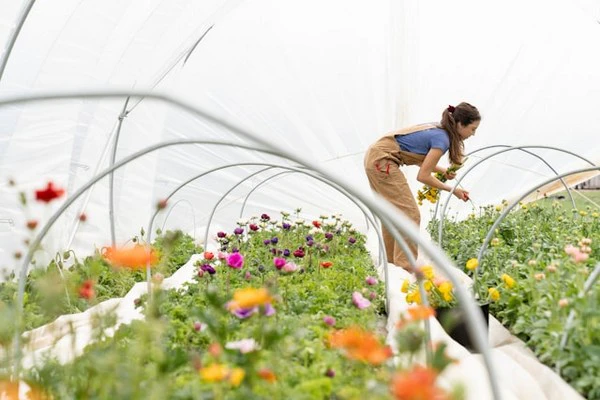
Choose flowers with different bloom times so something is always open. Think in three parts of the year.
- Spring can include native violets and serviceberry.
- Summer can include sunflowers and blanketflower.
- Fall can include goldenrod and New England aster.
A 2020 overview on garden support for insect pollinators explains how even small plantings can provide useful nectar and pollen if they flower across the season [4].
For a tiny patio, try pots of thyme for spring, zinnia for summer, and sedum for early fall.
Color and Shape
Bees see blues and purples well. Butterflies like flat landing pads. Tubular shapes help long-tongued bees and some butterflies.
A mix of flower shapes is best. One simple group is purple salvia for spikes, coreopsis for flat heads, and penstemon for tubes.
In one school plot, a 4 by 8 foot bed with lavender, cosmos, and bee balm brought in bumble bees, honey bees, and swallowtail butterflies during lunch time.
Native Choices
Plants that grow well in your region support local insects. They match the local climate and timing.
When in doubt, look for plants that you see along trails or in nearby parks. For example, in the Midwest, black-eyed Susan and purple coneflower do well.
In the Southwest, desert marigold and penstemon are sturdy.
Work on pollinator health and people notes that local green spaces and healthy pollinator communities connect to human well being, including food systems and nature contact [5].
Soil Quality Changes The Result
Plant health depends on soil, water, sunlight, pests and mineral balance.
Garden Setup
Sun Soil Water
Most flowering plants need at least 6 hours of sun. Start by watching where the sun hits your yard. Pick a spot that gets light from late morning to afternoon.
Soil should drain well, not stay soggy after rain. If soil is heavy, raise a bed 6 to 8 inches with compost and garden soil mix.
Water deeply two times per week during the first month to help roots. A shallow dish with pebbles makes a safe drink station for bees and butterflies. Refill it every two days so the water stays fresh.
Nesting and Hotels
Leave a small bare soil patch about 2 by 2 feet for ground-nesting bees. Keep it dry and sunny. Add a simple bee hotel for cavity nesters.
Use a block of untreated wood with drilled holes from 3 to 8 millimeters wide and 4 to 6 inches deep. Mount it under an eave facing east.
Replace the drilled block every 1 to 2 years to keep it clean. In a backyard test, one bee block and one bare patch led to leafcutter bees using both by mid summer.
Small Spaces
A window box, balcony, or steps can still help. Use one 12 inch pot for each season. Add a saucer with stones for water. Tie a small bunch of hollow stems together and hang it in a dry spot.
Use vs Avoid
| Use | Avoid |
|---|---|
| Compost | Overwatering |
| Clean water | Poor drainage |
| Healthy soil | Unknown sprays |
| Pest inspection | Ignoring soil problems |
Care Without Harm
Skip Harsh Sprays
Some sprays can harm bees and butterflies. Fungicides and other products can also change helpful microbes on leaves, which can affect plant health and insect visits [6].
Read labels carefully. If a product warns about bees or says to avoid when plants are in bloom, follow that.
Better yet, try non spray steps first. For a powdery mildew problem on cucumbers, prune a few crowded leaves and water at soil level in the morning instead of spraying right away.
Simple Pest Control
Use hands and water before chemicals. Knock aphids off with a strong water jet. Pick hornworms off tomatoes and move them to a far corner for birds.
Lay floating row covers on seedlings to block pests, then remove when flowers open so pollinators can reach them. Plant a decoy section.
For example, place nasturtiums 5 feet from your peppers to draw flea beetles away. These steps help protect pollinators because no poison is used on blooms they visit.
Water and Weeds
Keep plants watered deeply once or twice a week. Water in the morning so leaves dry by night. Pull weeds by hand around young plants so they do not compete.
Leave a small patch of clover or dandelions in spring as early food, then mow it short once your garden blooms are open.
Garden Check
Track and Share
Watch and Record
Spend 10 minutes, two times per week, counting visitors. Pick a sunny time with little wind. Stand still and note what you see.
Over months and years, your notes can show patterns.
Long term work has found that plant pollinator networks can change across decades, so your records help you adjust your plant mix if needed [3].
School and Neighbors
Share extra seedlings with a neighbor or your school. A simple flyer on your fence can list three plants that did well and when they bloomed.
Invite a friend to a 20 minute bug watch on a Saturday morning in July. Compare notes. Use this info to add one new early bloom next spring if your notes show a gap in April.
Fix and Improve
At the end of the season, list what worked.
Did summer have color but spring was bare? Then replace one summer flower with an early bloomer next year.
Did you see few butterflies but many bees? Add flat landing flowers like cosmos or yarrow.
Pollinator health connects to local plants, weather, and safe habitat, so small changes can help over time [1].
Suggested Posts
Evidence Limits
Research
Süle, G. et al. 2025. Pollinator-promoting interventions in European urban environments: a synthesis across 1051 sites. Landscape and Urban Planning. PMID: 39132773
Liang, H. et al. 2023. The effects of urbanization on pollinators and pollination: A meta-analysis. Ecology Letters. doi:10.1111/ele.14277
Bell, N.C.S. et al. 2023. Assessing five decades of garden bee studies: Trends, gaps and opportunities for urban pollinator conservation. Frontiers in Sustainable Cities. doi:10.3389/frsc.2023.1102360
Hall, D.M. et al. 2017. The city as a refuge for insect pollinators. Biological Conservation. doi:10.1016/j.biocon.2016.11.024
Baldock, K.C.R. et al. 2015. Where is the UK’s pollinator biodiversity? The importance of urban areas for flower-visiting insects. Proceedings of the National Academy of Sciences. doi:10.1073/pnas.1511482112
Threlfall, C.G. et al. 2015. The conservation value of urban green space habitats for Australian native bee communities. Landscape and Urban Planning. doi:10.1016/j.landurbplan.2015.02.014
Wenzel, A. et al. 2020. Grassland management affects pollinator communities in urban landscapes. Nature Communications. doi:10.1038/s41467-020-18870-6
Herrmann, J. et al. 2023. The degree of urbanisation reduces wild bee and butterfly diversity and alters plant–pollinator interactions. Scientific Reports. doi:10.1038/s41598-023-29275-8
Plant, E. et al. 2025. Supporting pollinators in urban gardens: Floral richness drives pollinator diversity across urban landscapes. Urban Ecosystems.
Brown, J. et al. 2024. Rapid responses of bees and butterflies but not birds to local habitat restoration in urban road verges. Journal of Applied Ecology. doi:10.1111/1365-2664.14648
Ayala-Azcárraga, C. et al. 2025. Presence of native pollinators in an urban park in Mexico City and their association with vegetation composition. Sustainability. doi:10.3390/su17020799
Matteson, K.C. and Langellotto, G.A. 2010. Small scale additions of native plants fail to increase beneficial insect richness in urban gardens. Annals of the Entomological Society of America. doi:10.1603/AN09124
Lowenstein, D.M., Matteson, K.C. and Minor, E.S. 2015. Diversity of wild bees supports pollination services in an urbanized landscape. Biodiversity and Conservation. doi:10.1007/s10531-015-0889-6
Garbuzov, M. and Ratnieks, F.L.W. 2014. Quantifying variation among garden plants in attractiveness to bees and other flower-visiting insects. Functional Ecology. doi:10.1111/1365-2435.12262
Frankie, G.W. et al. 2005. Ecological patterns of bees and their host ornamental flowers in two northern California cities. Journal of the Kansas Entomological Society.
Prudic, K.L. et al. 2022. Botanical gardens are local hotspots for urban butterflies in the southwestern United States. Insects. doi:10.3390/insects13100865
Braman, S.K. et al. 2022. Opportunities for and impediments to pollinator conservation in urban landscapes. Journal of Integrated Pest Management. doi:10.1093/jipm/pmac009
Torrez, V.C. et al. 2023. Pollinators and other insect visitations on native and ornamental perennial flowering plants in urban landscapes. HortScience. doi:10.21273/HORTSCI17279-23
Garibaldi, LA., Gomez, CARELLADS., Nabaes, JODARDN., Smith, MR., Timberlake, TP. and Myers, SS. (2022). Exploring connections between pollinator health and human health. Philosophical transactions of the Royal Society of London. Series B, Biological sciences. doi:10.1098/rstb.2021.0158. PMID: 35491592.
Zoller, L., Bennett, J. and Knight, TM. (2023). Plant-pollinator network change across a century in the subarctic. Nature ecology & evolution. doi:10.1038/s41559-022-01928-3. PMID: 36593294.
Laver, K. (2023). Developing age-friendly homes in age-friendly communities. Australian occupational therapy journal. doi:10.1111/1440-1630.12856. PMID: 36572656.
Rácz, IA., Szanyi, S. and Nagy, A. (2023). Review on flower-visiting behaviour of orthopterans and setting priorities for further studies. Biologia futura. doi:10.1007/s42977-024-00203-9. PMID: 38349457.
Stevenson, PC., Koch, H., Nicolson, SW. and Brown, MJF. (2022). Natural processes influencing pollinator health. Philosophical transactions of the Royal Society of London. Series B, Biological sciences. doi:10.1098/rstb.2021.0154. PMID: 35491596.
Majewska, AA. and Altizer, S. (2020). Planting gardens to support insect pollinators. Conservation biology : the journal of the Society for Conservation Biology. doi:10.1111/cobi.13271. PMID: 30593718.