Key Takeaways
- Lyme disease starts after an infected blacklegged tick passes Borrelia bacteria into your skin.
- Early signs can include fever, tiredness, aches, swollen glands and expanding skin rash.
- A clear bullseye rash can justify medical care before lab tests turn positive.
- Untreated Lyme disease can affect joints, nerves, the heart or daily energy.
- Natural support works best when it prevents bites and supports recovery after care.
Lyme Disease Basics
Main Cause
Lyme disease is an infection caused by Borrelia bacteria. In the United States, the main germ is Borrelia burgdorferi.
Blacklegged ticks spread it after feeding on infected animals, then biting people. CDC describes Lyme disease as a bacterial illness spread through blacklegged tick bites, with fever, rash and arthritis among possible signs (1).
The tick must attach and feed before the risk rises. A quick check after outdoor time can prevent real trouble.
Many people never feel the bite because young ticks are tiny. A nymph can look like a dark speck, then stay hidden behind the knee, near the waist or along the scalp.
Tick Range
Lyme disease is most common in the Northeast, upper Midwest and parts of the mid Atlantic United States. The range has grown over time as ticks spread into more counties.
CDC surveillance states that Lyme disease incidence and geographic range have increased since national tracking began in 1991 (2).
Blacklegged ticks live in wooded areas, leaf litter, tall grass and brush edges. Yards can also carry ticks when deer, mice and other animals move through them.
A person does not need deep forest exposure to get bitten. Gardening, walking a dog or clearing brush can be enough in a high tick area.
Symptoms & Stages
Early Signs
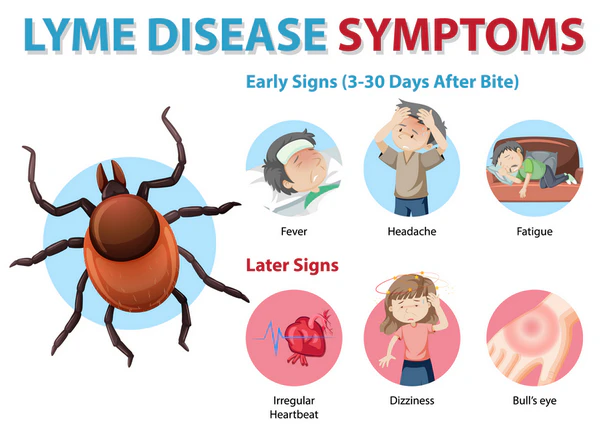
Early Lyme disease often starts three to thirty days after a tick bite. CDC lists fever, chills, headache, fatigue, muscle pain, joint pain, swollen lymph nodes and rash as early signs. The rash can expand slowly and may feel warm, but it may cause little pain or itching (3).
The classic bullseye rash gets most attention, but every rash does not look like a perfect target. Some rashes are solid red. Some are oval.
Some appear in darker skin with less obvious color change. A spreading rash after a possible tick bite should be treated as an important clue.
Later Problems
Untreated infection can spread through the body. Later signs may include facial droop, nerve pain, severe headache, stiff neck, heart rhythm symptoms or joint swelling.
CDC lists facial paralysis, irregular heartbeat and arthritis among possible signs of untreated Lyme disease (3).
Lyme arthritis often affects large joints. The knee is a common site. Swelling may come and go, then return with pain or stiffness.
Heart symptoms need fast attention because Lyme carditis can affect electrical signals in the heart. Shortness of breath, fainting, chest pain or palpitations deserve urgent medical care.
Long Symptoms
Some people report fatigue, pain or thinking problems after standard treatment. Researchers often call this post treatment Lyme disease symptoms or post treatment Lyme disease syndrome.
A 2024 systematic review found that studies on extra antibiotic treatment were mixed in design, with overall evidence showing no clear quality of life benefit from more antibiotics (4).
Coinfections, sleep loss, immune stress, poor food quality, mold exposure and other problems can keep a person feeling sick. A serious clinician should look for missed causes rather than dismiss symptoms.
Testing & Diagnosis
Rash First
A clear erythema migrans rash can be enough for diagnosis in the right setting. Blood tests can miss early infection because antibodies may take time to rise.
A review on Lyme serology states that erythema migrans is the best indicator of stage one infection and should prompt treatment without testing (5).
This is where timing matters. A negative early test does not always rule out Lyme disease. Testing becomes more useful after the immune system has had time to respond.
A clinician should connect the rash, symptoms, tick exposure and local risk instead of trusting one early lab result.
Blood Tests
Standard testing often uses a two step antibody process. The first test screens for possible Lyme antibodies.
The second test checks the result with more detail. Reviews explain that this two step method was designed to improve specificity because false positives can create confusion and wrong treatment paths (6).
Testing can also confuse people after old infection because antibodies may stay positive after the germ is gone.
A positive test must be read with symptoms and exposure. A negative test must be read with timing. Lyme diagnosis works best when the clinician knows both the limits of testing and the real story of the bite.
Natural Support
Bite Prevention
The strongest natural support is preventing the bite. Check your body after time in grass, brush or woods. Shower after outdoor work and look closely at warm hidden areas.
Use fine tweezers to remove a tick, then pull upward with steady pressure. Avoid crushing the tick into the skin.
Clothing helps when you enter tick areas. Long pants, tucked socks and light fabric can make ticks easier to spot. Keep grass short near the house and clear leaf litter where ticks hide.
CDC advises prevention steps such as avoiding tick habitat, checking the body and removing attached ticks quickly (7).
Food Support
Food support should help the body recover without feeding inflammation from weak foods. Choose whole, traditional meals built around eggs, wild seafood, poultry or tolerated ruminant foods when alpha gal is not present.
Use natural fats such as butter, ghee or tallow when tolerated. Avoid seed oils, fortified grains and ultra processed foods.
Carbohydrates can worsen energy swings and cravings when someone already feels drained. A lower carb diet built from real foods can keep blood sugar steadier.
Protein and animal fats give the body usable nutrients without relying on grains. Fermented foods such as kefir or sauerkraut may help some people when tolerated.
Recovery Basics
Sleep is not optional during recovery. Your immune system works harder when you sleep well. Keep the room dark and cool.
Get morning light outside when possible. Gentle walking can help circulation, but hard training during fever, joint swelling or heavy fatigue can push the body backward.
Mineral support can be useful when appetite, sweating or stress changes. Electrolytes, magnesium glycinate or magnesium malate may help some people when they match the person.
Food should remain the base. Supplements should never replace diagnosis when symptoms point toward infection.
Medical Care
Red Flags
Get medical care after a tick bite if you develop an expanding rash, fever, facial droop, joint swelling, nerve pain or heart symptoms. Early care gives the best chance of stopping spread.
Medical guidelines from IDSA, AAN and ACR cover prevention, diagnosis and treatment decisions for Lyme disease in North America (8).
Medicine can handle acute bacterial infection when used with good judgment. The problem comes when symptoms get dismissed, testing gets overtrusted or the whole person gets ignored.
Lyme care should take the infection seriously and still look at terrain, sleep, nutrition and other stressors.
Coinfection Clues
Ticks can carry more than one germ. A person with high fever, shaking chills, severe headache or low blood counts may need evaluation for other tick borne infections.
Coinfections can change the picture and may make the illness feel more intense than classic Lyme disease alone.
Do not assume every symptom after a tick bite is Lyme disease. Do not assume a weak test explains everything either. Look at location, timing, symptoms and labs together. That approach catches more real problems and avoids turning every vague symptom into one label.
For any health concerns or questions about a medical condition, get guidance from a physician or another appropriately trained clinician. Before changing your diet, supplements or health routine, talk with a licensed healthcare professional.
Research
CDC 2024, Lyme Disease, Centers for Disease Control and Prevention.
Kugeler, K.J. et al. 2024, Surveillance for Lyme Disease After Implementation of a Revised Case Definition, United States, 2022, Morbidity and Mortality Weekly Report, 73, 145 to 150. DOI 10.15585/mmwr.mm7306a1.
CDC 2024, Signs and Symptoms of Untreated Lyme Disease, Centers for Disease Control and Prevention.
Dersch, R. et al. 2024, Treatment of post treatment Lyme disease symptoms, a systematic review, European Journal of Neurology, 31. PMID 38606630.
Schriefer, M.E. 2015, Lyme Disease Diagnosis, Serology, Clinics in Laboratory Medicine, 35, 797 to 814. PMID 26593258.
Marques, A.R. 2015, Laboratory Diagnosis of Lyme Disease, Advances and Challenges, Infectious Disease Clinics of North America, 29, 295 to 307.
CDC 2026, Preventing Lyme Disease, Centers for Disease Control and Prevention.
Lantos, P.M. et al. 2021, Clinical Practice Guidelines by the Infectious Diseases Society of America, American Academy of Neurology, and American College of Rheumatology, 2020 Guidelines for the Prevention, Diagnosis and Treatment of Lyme Disease, Clinical Infectious Diseases, 72, e1 to e48. DOI 10.1093/cid/ciaa1215. PMID 33251776.
Mead, P. 2022, Epidemiology of Lyme Disease, Infectious Disease Clinics of North America, 36, 495 to 521. PMID 36116831.
Burgdorfer, W. et al. 1982, Lyme disease, a tick borne spirochetosis, Science, 216, 1317 to 1319. PMID 7043737.
Steere, A.C. et al. 1977, Lyme arthritis, an epidemic of oligoarticular arthritis in children and adults in three Connecticut communities, Arthritis and Rheumatism, 20, 7 to 17. PMID 836338.
Steere, A.C. et al. 1977, Erythema chronicum migrans and Lyme arthritis, cryoimmunoglobulins and clinical activity of skin and joints, Science, 196, 1121 to 1122. PMID 870973.
Wormser, G.P. 2006, Clinical practice, Early Lyme disease, New England Journal of Medicine, 354, 2794 to 2801. DOI 10.1056/NEJMcp061181. PMID 16807416.
Wormser, G.P. et al. 2006, The clinical assessment, treatment, and prevention of Lyme disease, human granulocytic anaplasmosis, and babesiosis, Clinical Infectious Diseases, 43, 1089 to 1134. PMID 17029130.
Khan, F. et al. 2022, Modified Two Tiered Testing Enzyme Immunoassay Algorithm for Lyme Disease Serology, Journal of Clinical Microbiology, 60. PMID 35612666.
Talbot, N.C. et al. 2023, Lyme Disease and Post treatment Lyme Disease Syndrome, Current Rheumatology Reports, 25, 187 to 196.
Bai, N.A. et al. 2023, Posttreatment Lyme disease syndrome and myalgic encephalomyelitis chronic fatigue syndrome, a systematic review, Frontiers in Medicine, 10. PMID 37711861.
Arvikar, S.L. and Steere, A.C. 2022, Lyme Arthritis, Infectious Disease Clinics of North America, 36, 563 to 577.
Marques, A. 2010, Lyme disease, a review, Current Allergy and Asthma Reports, 10, 13 to 20. PMID 20425509.
Barbour, A.G. and Fish, D. 1993, The biological and social phenomenon of Lyme disease, Science, 260, 1610 to 1616. PMID 8503006.