Key Takeaways
- Nutritional yeast is a savory seasoning with modest protein and B vitamins.
- Plain products can contain riboflavin but are not dependable vitamin B12 sources.
- Added vitamins in fortified products change labels without changing basic food quality.
- Research on yeast beta glucan suggests limited immune effects in specific settings.
- Nutritional yeast fits best as a small seasoning rather than a core food.
What is Nutritional Yeast
Inactive Yeast
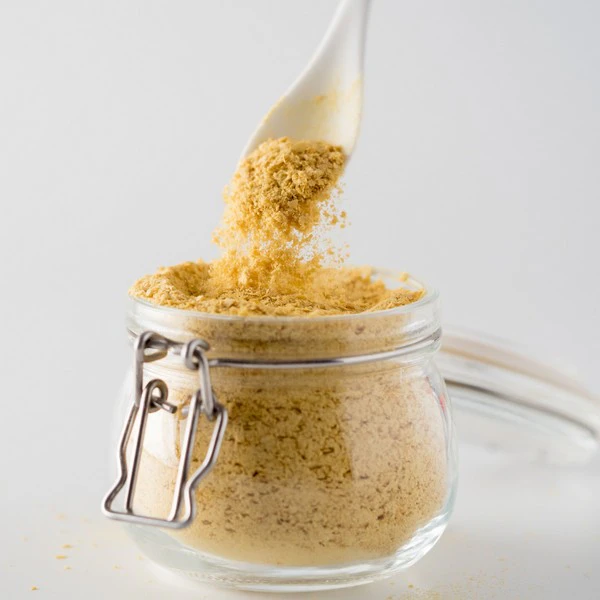
Nutritional yeast is an inactive form of Saccharomyces cerevisiae sold as flakes or powder with a savory taste. Harvard Health describes it as a seasoning used for a cheese like flavor, not as a stand alone staple food (1).
Most people use one to three tablespoons at a time on eggs, meat, soups or cooked vegetables. That small serving size keeps expectations grounded. A label can look impressive while the actual amount eaten stays fairly modest. Nutrition data for plain products show some protein plus small to moderate amounts of several B vitamins, though values differ from one product to another (2, 3).
Product Differences
The biggest point of confusion is the gap between plain products and fortified products. Some brands add synthetic vitamins after processing. That practice changes the label more than it changes the underlying food. Harvard Health notes that many store products are fortified and that processors add vitamins because several are either absent or present in lower amounts naturally (1). Added vitamins on a package do not make nutritional yeast a superior food. They make it a processed product with added inputs. Anyone trying to judge the health value of nutritional yeast should separate naturally present nutrients from nutrients sprayed on later.
What It Naturally Offers
Riboflavin & Protein
Riboflavin is one of the more relevant nutrients naturally linked with yeast. Harvard T.H. Chan explains that riboflavin helps enzyme systems carry out daily body functions, including energy related work inside cells (4).
Plain nutritional yeast can provide riboflavin without relying on fortification. That gives it some value as a small extra in the diet, though it still remains a condiment. Product listings for plain flakes also show a modest protein contribution per serving, which can be useful but does not put it in the same class as eggs, meat or dairy for total protein intake (2, 3).
Older human work on baker’s yeast found that vitamin availability varied with the form of the yeast and its nutrient content. That study is old, but it still supports a sensible point. The body does not absorb every listed nutrient in a simple one for one way just because a package prints a number (5).
B12 Reality
Vitamin B12 is where the marketing often runs ahead of the food itself. Harvard T.H. Chan states that vitamin B12 is naturally found in animal foods and can also be added to foods or supplements (6). The NIH fact sheet says the same thing in more formal language and explains that B12 is naturally present in some foods and added to others (7).
Plain nutritional yeast should not be treated as a reliable B12 source. If a product contains B12 because a manufacturer added it, that is a fortification story, not a natural nutrient story. For readers who want to know what nutritional yeast itself offers, the honest answer is narrower than many labels suggest.
What The Immune Research Shows
Beta Glucan Studies
Much of the health interest around nutritional yeast comes from beta glucan, a component of the yeast cell wall. A review in Molecular Nutrition and Food Research found that orally administered yeast derived beta glucans showed immune modulating effects, while also noting that results depended on the source, structure and dose used (8).
A second review in Nutrition Journal also reported immune modulating findings for dietary yeast beta glucan and summarized several human studies with encouraging but uneven results (9).
Some individual trials found fewer symptoms or milder upper respiratory complaints in healthy adults given yeast beta glucan. Those results appeared in studies of healthy subjects, older adults and people under heavy exercise stress, which suggests a possible effect under strain rather than a universal result in everyday life (10, 11, 12).
Limits Of Those Findings
Those immune studies do not prove that a spoonful of nutritional yeast at dinner will protect someone from infection. Many of the trials used isolated beta glucan preparations in set doses, not ordinary kitchen use of yeast flakes. Some studies were also small, narrow or focused on athletes and older adults rather than broad populations.
A recent pilot trial reported improved antibody response after influenza vaccination with yeast beta glucan, but a pilot trial is an early signal rather than a final answer (13). Several exercise related trials also reported less illness burden or lower inflammatory markers, though those settings are specialized and do not settle what happens in normal daily life (14, 15, 16, 17).
Yeast beta glucan looks interesting. It does not justify sweeping claims for nutritional yeast as a daily immune solution.
How To Use It Sensibly
Best Use At Meals
Nutritional yeast works best as a flavoring. A tablespoon over scrambled eggs, ground beef, broth based soups or roasted vegetables adds a savory note without changing the structure of the meal. It can help simple food taste richer, which is useful when someone wants more variety without relying on highly processed sauces.
Nutritional yeast is not a replacement for nutrient dense animal foods. It does not match red meat, eggs, dairy, liver or shellfish for natural B12, complete protein, fat soluble vitamins or mineral density. Used in that smaller role, it can be a pleasant extra rather than a nutritional crutch.
Label Checks
These label checks help keep the product in perspective.
- Choose plain products when you want to know what the yeast itself contains.
- Treat fortified labels as added vitamin labels rather than food quality signals.
- Check serving size, protein and sodium before assuming the product is substantial.
- Start with a small amount if yeast products upset your digestion.
Small daily amounts are common, though tolerance varies. People with digestive sensitivity, headaches triggered by certain foods or a known yeast issue may do better with careful use.
Before changing your diet, supplements or health routine, talk with a licensed healthcare professional. For any health concerns or questions about a medical condition, get guidance from a physician or another appropriately trained clinician.
FAQs
Is nutritional yeast healthy?
It can be a useful seasoning with some protein and naturally present B vitamins. Its value depends on the product, the serving size and how much importance someone places on avoiding added synthetic vitamins.
Does plain nutritional yeast have vitamin B12?
Plain nutritional yeast should not be treated as a dependable source of vitamin B12. When B12 appears on many labels, it is often there because the product was fortified after processing.
Should fortified nutritional yeast be avoided?
Anyone following a whole food approach may prefer to avoid fortified products because added vitamins do not improve the underlying food itself. Reading the ingredient panel is the easiest way to tell the difference.
Can nutritional yeast support immune health?
Research on yeast beta glucan suggests possible immune effects in some settings. The evidence is limited and does not support broad promises from normal food use.
How much nutritional yeast can you eat in a day?
Many people use one to three tablespoons across one or two meals. That keeps it in the role of a seasoning and gives a fair chance to judge taste and tolerance.
Research
Harvard Health Publishing (2025) ‘Nutritional yeast: Does this savory, vegan seasoning pack a nutritional punch?’. Available at: https://www.health.harvard.edu/diet-and-nutrition/nutritional-yeast-does-this-savory-vegan-seasoning-pack-a-nutritional-punch (Accessed: 13 April 2026).
NutritionValue (n.d.) ‘Nutritional yeast, non fortified’. Available at: https://www.nutritionvalue.org/public_ingredient_52549.html (Accessed: 13 April 2026).
Anthony’s Goods (2026) ‘Non Fortified Nutritional Yeast Flakes’. Available at: https://anthonysgoods.com/products/non-fortified-nutritional-yeast-flakes-gluten-free-vegan-non-gmo (Accessed: 13 April 2026).
Harvard T.H. Chan School of Public Health (n.d.) ‘Riboflavin, Vitamin B2’. Available at: https://nutritionsource.hsph.harvard.edu/riboflavin-vitamin-b2/ (Accessed: 13 April 2026).
Kingsley, H.N. and Parsons, H.T. (1947) ‘The availability of vitamins from yeasts; the influence of the ingestion of fresh and dried bakers’ yeasts varying in viability and in thiamine content on the availability of thiamine to human subjects’, Journal of Nutrition, 34(3), pp. 321 to 331. Available at: https://jn.nutrition.org/article/S0022-3166%2823%2918616-0/fulltext (Accessed: 13 April 2026).
Harvard T.H. Chan School of Public Health (n.d.) ‘Vitamin B12’. Available at: https://nutritionsource.hsph.harvard.edu/vitamin-b12/ (Accessed: 13 April 2026).
NIH Office of Dietary Supplements (2025) ‘Vitamin B12 Health Professional Fact Sheet’. Available at: https://ods.od.nih.gov/factsheets/VitaminB12-HealthProfessional/ (Accessed: 13 April 2026).
Samuelsen, A.B.C., Schrezenmeir, J. and Knutsen, S.H. (2014) ‘Effects of orally administered yeast derived beta glucans: a review’, Molecular Nutrition & Food Research, 58(1), pp. 183 to 193. Available at: https://doi.org/10.1002/mnfr.201300338 (Accessed: 13 April 2026).
Stier, H., Ebbeskotte, V. and Gruenwald, J. (2014) ‘Immune modulatory effects of dietary Yeast Beta 1,3/1,6 D glucan’, Nutrition Journal, 13, 38. Available at: https://doi.org/10.1186/1475-2891-13-38 (Accessed: 13 April 2026).
Dharsono, T. et al. (2019) ‘Effects of Yeast (1,3) (1,6) Beta Glucan on Severity of Upper Respiratory Tract Infections: A double blind, randomized, placebo controlled study in healthy subjects’, Journal of the American College of Nutrition, 38(1), pp. 40 to 50. Available at: https://doi.org/10.1080/07315724.2018.1478339 (Accessed: 13 April 2026).
Auinger, A. et al. (2013) ‘Yeast (1,3) (1,6) beta glucan helps to maintain the body’s defence against pathogens: a double blind, randomized, placebo controlled, multicentric study in healthy subjects’, European Journal of Nutrition, 52(8), pp. 1913 to 1918. Available at: https://doi.org/10.1007/s00394-013-0492-z (Accessed: 13 April 2026).
Fuller, R. et al. (2017) ‘Yeast derived β 1,3/1,6 glucan, upper respiratory tract infection and innate immunity in older adults’, Nutrition, 39 to 40, pp. 30 to 35. Available at: https://doi.org/10.1016/j.nut.2017.03.003 (Accessed: 13 April 2026).
Moreno, M.L. et al. (2025) ‘Yeast Beta Glucan Enhances Antibody Response Following Influenza Vaccination A double blind, randomized, placebo controlled pilot trial’, Journal of Dietary Supplements, 22(5), pp. 795 to 810. Available at: https://doi.org/10.1080/19390211.2025.2539876 (Accessed: 13 April 2026).
Mah, E. et al. (2020) ‘Soluble and Insoluble Yeast β Glucan Differentially Affect Upper Respiratory Tract Infection in Marathon Runners: A double blind, randomized placebo controlled trial’, Journal of Medicinal Food, 23(4). Available at: https://doi.org/10.1089/jmf.2019.0076 (Accessed: 13 April 2026).
Mah, E. et al. (2020) ‘Beverage Containing Dispersible Yeast β Glucan Decreases Cold Flu Symptomatic Days After Intense Exercise: A randomized controlled trial’, Journal of Dietary Supplements, 17, pp. 200 to 210. Available at: https://doi.org/10.1080/19390211.2018.1495676 (Accessed: 13 April 2026).
Zabriskie, H.A. et al. (2020) ‘Yeast Beta Glucan Supplementation Downregulates Markers of Systemic Inflammation after Heated Treadmill Exercise’, Nutrients, 12(4), 1144. Available at: https://doi.org/10.3390/nu12041144 (Accessed: 13 April 2026).
McFarlin, B.K. et al. (2024) ‘Baker’s yeast beta glucan supplementation was associated with an improved innate immune mRNA expression response after exercise’, Methods, 230, pp. 68 to 79. Available at: https://doi.org/10.1016/j.ymeth.2024.07.013 (Accessed: 13 April 2026).
Sari Foods (2026) ‘Nutritional Yeast Flakes’. Available at: https://sarifoods.co/products/nutritional-yeast-flakes (Accessed: 13 April 2026).
Moyad, M.A. (2008) ‘Brewer’s baker’s yeast (Saccharomyces cerevisiae) and preventive medicine: Part II’, Urologic Nursing, 28(1), pp. 73 to 75. Available at: https://pubmed.ncbi.nlm.nih.gov/18251359/ (Accessed: 13 April 2026).