
Key Takeaways
- Meat impact changes a lot with feed, land and manure management.
- Methane behaves differently from carbon dioxide over time in the air.
- Land use claims often blur cropland, pasture and rough grazing land.
- Feedlots and feed monocrops drive much of the avoidable damage.
- Better sourcing can lower harm without removing meat from the diet.
Production Systems Matter
Pasture & Feedlot
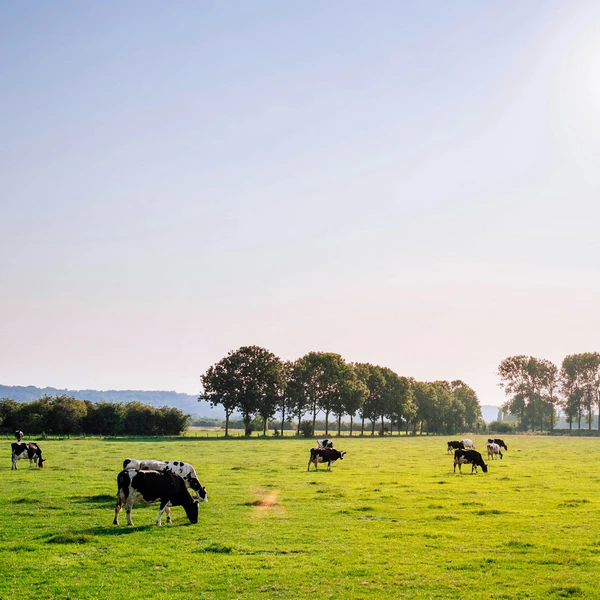
Meat does not come from one uniform system. A cow finished in a feedlot with grain from large monocrops has a very different footprint from a cow raised mostly on pasture, and both differ again from mixed systems that use pasture for most of life and grain for a short finishing phase. Large reviews of life cycle studies show wide variation inside beef, not just between beef and plant foods (1, 2, 3).
Some feedlot systems use less land per kilogram of beef because cattle grow faster and spend fewer days alive. Some pasture systems can lower net climate impact when they improve soil carbon and rely less on feed crops. Those gains are not automatic. They depend on stocking rate, rainfall, soil type, grazing management and whether pasture replaces native ecosystems or restores degraded ground (1, 4, 5).
Inputs & Waste
The biggest pressure points in intensive meat systems often come from outside the animal itself. Feed production uses fertilizer, fuel, pesticides, irrigation water and transport. Manure storage can create methane, nitrous oxide, ammonia and local water pollution when too much waste piles up in one place. Reviews across livestock products keep finding the same hotspots, which are feed, manure and energy use (6, 7, 8).
A simple claim that meat is always bad misses where the damage clusters. A better question is where the feed came from, how the animals were managed and whether waste stayed in a loop on land or turned into a disposal problem.
Methane & Carbon
Different Gas Behavior
Methane is a powerful warming gas, but it does not behave like carbon dioxide. Carbon dioxide accumulates and a share stays in the atmosphere for a very long time. Methane breaks down much faster, so a stable methane source does not warm the planet in the same way as a growing stream of fossil carbon dioxide. That difference is central when people compare cattle with cars, coal or oil (9, 10, 11).
That does not erase methane. Rising methane from livestock adds warming, and lowering it can cool faster than cutting carbon dioxide alone over short time windows. Researchers who study methane accounting argue that the usual one size fits all climate metric can misread the warming effect of livestock systems that hold methane steady versus systems that expand (9, 10, 12).
Why Framing Counts
Many headlines convert everything into one carbon dioxide equivalent number and stop there. That is useful for broad accounting, but it can flatten real differences between a long lived stock pollutant and a shorter lived flow pollutant. For meat, the result is often more heat than light.
A fair view keeps both ideas in place at once. Cattle methane needs attention, especially where herds are growing or manure is concentrated. Fossil carbon dioxide remains the deeper long term driver of warming because it keeps stacking up in the atmosphere. Putting those gases in the same bucket without explanation confuses readers more than it helps them (9, 10, 11).
Land Use Reality
Cropland vs Rangeland
Land use claims about meat often mix very different kinds of land. Cropland can grow food that people eat directly. Rangeland often cannot. Dry grasslands, steep hills and rough pasture are not interchangeable with fertile cropland. When studies count all land the same way, meat can look worse without showing whether that land had any realistic crop alternative (13, 14, 2).
Ruminants can turn grasses and byproducts into food on land unsuited to arable farming. Global feed studies estimate that most livestock feed is not directly edible by humans, though the share of human edible feed rises in intensive systems that rely heavily on grain and soy (14).
What Land Burden Really Means
Land burden still counts. Beef usually needs more land than pork, chicken, eggs or milk when measured per kilogram of product. Several reviews support that point. The missing nuance is that the quality and opportunity cost of land differ a lot across systems (6, 7, 8).
Using scarce cropland to grow feed for confined animals creates more direct competition with the human food supply than using well managed pasture on land with few cropping options. Land debates get clearer when cropland, pasture and rough grazing land are kept separate.
Feedlots & Monocrops
Where Damage Concentrates
Feedlots are efficient in one narrow sense. They pack weight gain into less time and less land. Yet that efficiency can shift pressure into other parts of the system. Grain production for feed can mean soil loss, fertilizer runoff, pesticide exposure, heavy fuel use and irrigation demand. Manure held at high density can overwhelm local land capacity and raise water and air pollution risk (7, 8, 15).
Monocrops are the hidden engine behind a large share of modern meat damage. Corn and soy grown in vast single crop rotations can degrade soil structure, reduce habitat and tie animal agriculture to synthetic fertilizer. A narrow attack on meat alone can miss that industrial crop model is doing much of the ecological harm.
Better Sourcing
Better sourcing is a real lever. Meta analysis suggests beef emissions can fall with improved grazing, better manure handling, higher reproductive efficiency and land management that lifts soil carbon where conditions allow (1, 4).
A useful shopping filter starts with a few plain questions. Was the animal raised mostly on pasture. Was it tied to a local or regional system with less transport and less feed concentration. Did the farm rely on diverse forage rather than heavy grain finishing. Was manure cycled back onto land instead of treated like waste. Those questions do more than a simple plant versus meat split.
Some pasture systems still use too much land. Some feedlot systems still score lower on one climate metric. Real world tradeoffs stay messy. The strongest point is simple. Meat impact depends on the production system, and the biggest avoidable harms often sit in feedlots, feed monocrops and waste concentration rather than in meat as a category by itself.
Before changing your diet, supplements or health routine, talk with a licensed healthcare professional. For any health concerns or questions about a medical condition, get guidance from a physician or another appropriately trained clinician.
FAQs
Is meat bad for the environment?
Meat can have a high environmental burden, especially beef, but the scale of harm changes a lot by system. Feed source, manure handling, land type and grazing practice all change the result.
Does methane from cattle work like carbon dioxide?
No. Methane is stronger in the short term but it breaks down much faster. Carbon dioxide accumulates for far longer and keeps adding to long term warming.
Are feedlots worse for the environment?
Feedlots can use less land and time per kilogram of beef, but they often shift pressure into grain production, manure concentration and local pollution. Looking only at one metric can hide that tradeoff.
Does grass fed beef always have a lower impact?
No. Some grass based systems can lower net climate burden in certain settings, especially when soil carbon improves. Some also use much more land and may not perform better overall.
Can better sourcing reduce meat impact without going plant only?
Yes. Choosing meat from systems with better pasture management, lower feed crop dependence and better manure cycling can reduce harm even if meat stays in the diet.
Research
Cusack, D.F., Kazanski, C.E., Hedberg, H.K., Reyes, P.M. and Cacho, O.J. (2021) ‘Reducing climate impacts of beef production: A synthesis of life cycle assessments across management systems and global regions’, Global Change Biology, 27(9), pp. 1721 to 1736. Available at https://onlinelibrary.wiley.com/doi/full/10.1111/gcb.15509
de Vries, M., van Middelaar, C.E. and de Boer, I.J.M. (2015) ‘Comparing environmental impacts of beef production systems: A review of life cycle assessments’, Livestock Science, 178, pp. 279 to 288. Available at https://research.wur.nl/en/publications/comparing-environmental-impacts-of-beef-production-systems-a-revi/
Poore, J. and Nemecek, T. (2018) ‘Reducing food’s environmental impacts through producers and consumers’, Science, 360(6392), pp. 987 to 992. Available at https://www.science.org/doi/10.1126/science.aaq0216
Stanley, P.L., Rowntree, J.E., Beede, D.K., DeLonge, M.S. and Hamm, M.W. (2018) ‘Impacts of soil carbon sequestration on life cycle greenhouse gas emissions in Midwestern USA beef finishing systems’, Agricultural Systems, 162, pp. 249 to 258. Available at https://www.sciencedirect.com/science/article/pii/S0308521X17310338
Capper, J.L. (2012) ‘Is the Grass Always Greener? Comparing the Environmental Impact of Conventional, Natural and Grass Fed Beef Production Systems’, Animals, 2(2), pp. 127 to 143. Available at https://www.mdpi.com/2076-2615/2/2/127
de Vries, M. and de Boer, I.J.M. (2010) ‘Comparing environmental impacts for livestock products: A review of life cycle assessments’, Livestock Science, 128(1 to 3), pp. 1 to 11. Available at https://research.wur.nl/en/publications/comparing-environmental-impacts-for-livestock-products-a-review-o/
Gerber, P.J., Mottet, A., Opio, C.I., Falcucci, A. and Teillard, F. (2015) ‘Environmental impacts of beef production: Review of challenges and perspectives for durability’, Meat Science, 109, pp. 2 to 12. Available at https://research.wur.nl/en/publications/environmental-impacts-of-beef-production-review-of-challenges-and/
Eshel, G., Shepon, A., Makov, T. and Milo, R. (2014) ‘Land, irrigation water, greenhouse gas, and reactive nitrogen burdens of meat, eggs, and dairy production in the United States’, Proceedings of the National Academy of Sciences of the United States of America, 111(33), pp. 11996 to 12001. Available at https://www.pnas.org/doi/10.1073/pnas.1402183111
Allen, M.R., Shine, K.P., Fuglestvedt, J.S., Millar, R.J., Cain, M., Frame, D.J. and Macey, A.H. (2018) ‘A solution to the misrepresentations of CO2 equivalent emissions of short lived climate pollutants under ambitious mitigation’, npj Climate and Atmospheric Science, 1, 16. Available at https://www.nature.com/articles/s41612-018-0026-8
Lynch, J., Cain, M., Frame, D. and Pierrehumbert, R. (2021) ‘Agriculture’s Contribution to Climate Change and Role in Mitigation Is Distinct From Predominantly Fossil CO2 Emitting Sectors’, Frontiers in Sustainable Food Systems, 4, 518039. Available at https://www.frontiersin.org/journals/sustainable-food-systems/articles/10.3389/fsufs.2020.518039/full
McAuliffe, G.A., Lynch, J., Cain, M., Buckingham, S. and Takahashi, T. (2023) ‘Are single global warming potential impact assessments adequate for carbon footprints of agri food systems?’, Environmental Research Letters, 18(8), 084014. Available at https://pure.sruc.ac.uk/en/publications/are-single-global-warming-potential-impact-assessments-adequate-f/
Reisinger, A., Clark, H., Cowie, A.L., Emmet Bojtor, Z., Harris, M., Kelliher, F. and others (2021) ‘How necessary and feasible are reductions of methane emissions from livestock to support stringent temperature goals?’, Philosophical Transactions of the Royal Society A, 379(2210), 20200452. Available at https://royalsocietypublishing.org/rsta/article/379/2210/20200452/111941/How-necessary-and-feasible-are-reductions-of
Van Zanten, H.H.E., Herrero, M., van Hal, O., Röös, E., Muller, A., Garnett, T., Gerber, P.J., Schader, C. and de Boer, I.J.M. (2018) ‘Defining a land boundary for sustainable livestock consumption’, Global Change Biology, 24(9), pp. 4185 to 4194. Available at https://onlinelibrary.wiley.com/doi/full/10.1111/gcb.14321
Mottet, A., de Haan, C., Falcucci, A., Tempio, G., Opio, C. and Gerber, P. (2017) ‘Livestock: On our plates or eating at our table? A new analysis of the feed food debate’, Global Food Security, 14, pp. 1 to 8. Available at https://www.sciencedirect.com/science/article/pii/S2211912416300013
Clark, M. and Tilman, D. (2017) ‘Comparative analysis of environmental impacts of agricultural production systems, agricultural input efficiency, and food choice’, Environmental Research Letters, 12(6), 064016. Available at https://experts.umn.edu/en/publications/comparative-analysis-of-environmental-impacts-of-agricultural-pro/
Greenwood, P.L. (2021) ‘Review: An overview of beef production from pasture and feedlot globally, as demand for beef and the need for sustainable practices increase’, Animal, 15, 100295. Available at https://www.sciencedirect.com/science/article/pii/S1751731121001385