
Key Takeaways
- Black seed oil comes from Nigella sativa, also called black cumin.
- Skin research is more developed than the evidence for hair growth.
- Hair loss studies exist, but most are small and narrowly focused.
- Oral use shows modest metabolic effects in short human trials.
- Patch testing and medicine checks are sensible before trying it.
Black Seed Oil Benefits
Nigella Sativa
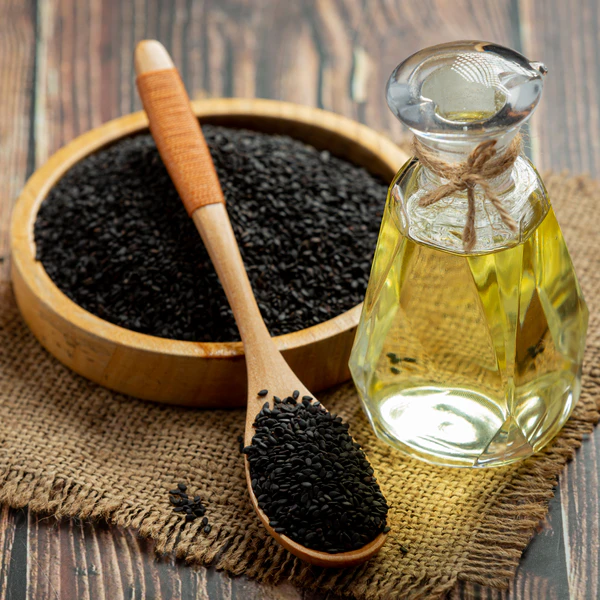
Black seed oil comes from the seeds of Nigella sativa, a plant often called black cumin. Most discussion of black seed oil benefits centers on thymoquinone, a compound studied for anti inflammatory and antioxidant activity. Human research exists, but much of it is still early, condition specific and quite small. (1)
Interest in black seed oil for skin and hair is driven more by targeted findings than by broad proof of beauty or wellness effects. A 2022 systematic review of randomized trials found encouraging results for several skin conditions, yet the authors were working with a limited pool of studies that varied in form and follow up time. Those limits make it hard to treat black seed oil as a settled answer for everyday cosmetic use. (2)
Black Seed Oil For Skin
Black seed oil for skin gets the strongest clinical attention in small studies of acne, eczema, psoriasis and other inflammatory conditions. Cleveland Clinic notes one acne gel study in which severity fell after twice daily use for 60 days, while the broader review found topical Nigella sativa products looked more promising than oral products for skin disease overall. Strong proof is still missing because most trials were brief and involved small samples. (1, 2)
One reason black cumin seed oil for skin care attracts attention is that the better trials focus on inflamed or irritated skin rather than vague claims of a glow. In a randomized trial of hand eczema, topical Nigella performed about as well as betamethasone for symptom improvement and quality of life measures. Results like that are encouraging, but they do not prove that every serum or straight oil will help acne scars, dry patches or daily barrier care. (3)
Skin use still needs care. Safety reviews report that Nigella sativa products are generally well tolerated, but topical reactions and irritation can occur, especially on already inflamed skin. A patch test on a small area before wider use is a sensible first step. (4, 10)
Black Seed Oil For Hair
Scalp & Shedding
Black seed oil for hair growth is one of the most popular claims online, but the direct evidence is thin. The most cited human trial is a small randomized pilot study in telogen effluvium, a form of diffuse shedding, where a 0.5 percent Nigella lotion used daily for three months improved hair density and thickness in the treatment group. Those results are worth noting because they suggest black seed oil can help with hair loss linked to scalp inflammation or shedding, yet they do not show that black seed oil is good for hair growth in common hereditary thinning or routine thinning. Claims about black seed oil for scalp and dandruff are still ahead of the clinical evidence. (5)
Wellness Claims & Safety
Overall
Oral black seed oil research usually focuses on measurable metabolic markers rather than a broad sense of wellness. Systematic reviews and meta analyses have reported improvements in fasting glucose, blood lipids and some inflammatory markers in adults, especially in short term trials and in people with existing metabolic risk. Those findings support interest in black cumin seed oil benefits, but they do not show a universal benefit for healthy people or long term disease prevention. (6, 7)
Updated reviews have also found modest improvements in lipid profiles and blood pressure, which helps explain why black seed oil keeps appearing in general wellness conversations. Study quality is mixed, product forms differ and doses are not standardized across trials. A capsule, a cold pressed oil and a mixed herbal formula cannot be assumed to act the same way. (8, 9)
The clearest reading of the evidence is fairly narrow. Black seed oil looks promising for a few targeted uses, especially some skin conditions and some metabolic markers, but the research base is not broad enough to call it a proven wellness staple. Most of the encouraging data comes from short studies, so long term benefit and long term safety are still less clear than many marketing claims suggest. (6, 8, 9)
Side Effects & Caution
Black seed oil side effects are usually described as mild, but mild does not mean trivial. Reviews and consumer guidance note possible stomach upset with oral use, skin irritation with topical use and interaction concerns because Nigella sativa may affect drug handling in the body. Extra care is wise for people who are pregnant or who use medicines that affect blood sugar, blood pressure or clotting. (4, 10)
Black seed oil is easier to think about as an optional add on than as a fix for acne, psoriasis, hair loss or general health. Start with a patch test for skin use, avoid high oral doses and speak with a clinician before combining it with regular medicines. A cautious approach fits the evidence better than the cure all language often used online. (1, 10)
For any health concerns or questions about a medical condition, get guidance from a physician or another appropriately trained clinician. Before changing your diet, supplements or health routine, talk with a licensed healthcare professional.
FAQs
Can black seed oil help hair growth?
It may help in some cases of shedding linked to telogen effluvium, but the human evidence is still limited. Claims for routine hair growth or common hereditary thinning go well beyond what current studies can support.
Is black seed oil good for acne prone skin?
Some small studies suggest it may help reduce acne severity, especially in topical products. Sensitive or damaged skin still needs caution because irritation is possible.
Can you use black seed oil on your scalp every day?
Some studies used daily scalp application, but there is no standard routine that suits everyone. A patch test and a gradual start are safer than heavy daily use right away.
Is black seed oil safe to take by mouth?
Short term use appears reasonably well tolerated in many studies, but stomach upset and medicine interactions are possible. Long term safety is less clear than the marketing around it.
Which people should avoid black seed oil?
People who are pregnant, those with a history of reactions to topical oils and anyone taking medicines for blood sugar, blood pressure or clotting should be careful. Medical guidance is also sensible for people with liver or kidney concerns.
Research
Cleveland Clinic (2024) Black Seed Oil Benefits for Your Health. Health Essentials, 26 June.
Nasiri, N. et al. (2022) The Therapeutic Effects of Nigella sativa on Skin Disease. Evidence Based Complementary and Alternative Medicine, 2022, Article ID 7993579.
Yousefi, M. et al. (2013) Comparison of therapeutic effect of topical Nigella with Betamethasone and Eucerin in hand eczema. Journal of the European Academy of Dermatology and Venereology. DOI 10.1111/jdv.12033.
Mashayekhi-Sardoo, H., Rezaee, R. and Karimi, G. (2020) Nigella sativa black seed safety an overview. Asian Biomedicine, 14(4), pp. 127 to 137.
Rossi, A. et al. (2013) Evaluation of a Therapeutic Alternative for Telogen Effluvium A Pilot Study. Journal of Cosmetics, Dermatological Sciences and Applications, 3(3A), pp. 9 to 16.
Hallajzadeh, J. et al. (2020) Effects of Nigella sativa on glycemic control, lipid profiles, and biomarkers of inflammatory and oxidative stress. Phytotherapy Research, 34, pp. 2586 to 2608.
Askari, G. et al. (2019) Effect of Nigella sativa supplementation on glycemic control. Phytotherapy Research, 33(5), pp. 1341 to 1352.
Rounagh, M. et al. (2024) Effects of Nigella sativa supplementation on lipid profiles in adults. Clinical Nutrition ESPEN, 61, pp. 168 to 180.
Kavyani, Z. et al. (2023) Antihypertensive effects of Nigella sativa supplementation. Phytotherapy Research, 37(8), pp. 3224 to 3238.
Healthline (2024) Black Seed Oil Health Benefits Uses and Side Effects. Healthline, 15 August.
Kavyani, Z. et al. (2023) The effect of Nigella sativa black seed on biomarkers of inflammatory and oxidative stress. Inflammopharmacology.
Sahebkar, A. et al. (2016) Nigella sativa black seed effects on plasma lipid concentrations in humans. Pharmacological Research, 106, pp. 37 to 50.
Namazi, N. et al. (2018) The effects of Nigella sativa L. on obesity. Journal of Ethnopharmacology, 219, pp. 173 to 181.
Tavakoly, R. et al. (2019) The effect of Nigella sativa L. supplementation on serum C reactive protein. Complementary Therapies in Medicine, 45, pp. 149 to 155.
Montazeri, R.S. et al. (2021) The effect of Nigella sativa on biomarkers of inflammation and oxidative stress. Journal of Food Biochemistry, 45, e13625.
Huseini, H.F. et al. (2013) Blood Pressure Lowering Effect of Nigella sativa L. Seed Oil in Healthy Volunteers. Phytotherapy Research, 27(12), pp. 1849 to 1853.
Koshak, A. et al. (2017) Nigella sativa Supplementation Improves Asthma Control and Biomarkers. Phytotherapy Research, 31(3), pp. 403 to 409.
Salem, A.M. et al. (2017) Effect of Nigella sativa supplementation on lung function and inflammatory mediators in partly controlled asthma. Annals of Saudi Medicine, 37(1), pp. 64 to 71.
Farhangi, M.A. et al. (2016) The effects of Nigella sativa on thyroid function, serum VEGF 1, Nesfatin 1 and anthropometric features in patients with Hashimoto’s thyroiditis. BMC Complementary and Alternative Medicine, 16, p. 471.
Farhangi, M.A. and Tajmiri, S. (2020) The effects of powdered black cumin seeds on markers of oxidative stress, endothelial function and serum lipids in patients with Hashimoto’s thyroiditis. Clinical Nutrition ESPEN.
Farhangi, M.A., Dehghan, P. and Tajmiri, S. (2018) Powdered black cumin seeds strongly improves serum lipids, atherogenic index of plasma and modulates anthropometric features in patients with Hashimoto’s thyroiditis. Lipids in Health and Disease, 17, p. 59.
Huseini, H.F. et al. (2022) Efficacy and safety of oral Nigella sativa oil for symptomatic treatment of knee osteoarthritis. Complementary Therapies in Clinical Practice, 49, p. 101666.
Nikakhlagh, S. et al. (2011) Herbal treatment of allergic rhinitis The use of Nigella sativa. American Journal of Otolaryngology, 32(5), pp. 402 to 407.
Işik, H. et al. (2010) Potential adjuvant effects of Nigella sativa seeds to improve specific immunotherapy in allergic rhinitis patients. Medical Principles and Practice, 19(3), pp. 206 to 211.
Salem, E.M. et al. (2010) Comparative study of Nigella sativa and triple therapy in eradication of Helicobacter pylori in patients with non ulcer dyspepsia. Saudi Journal of Gastroenterology, 16(3), pp. 207 to 214.
Kalus, U. et al. (2003) Effect of Nigella sativa black seed on subjective feeling in patients with allergic diseases. Phytotherapy Research, 17(10), pp. 1209 to 1214.
Treatment Rooms London (n.d.) Can Black Seed Oil Help Hair Growth. Treatment Rooms London.