
Key Takeaways
- Cold plunge suits quick alertness, fast cooling after heat and short stress practice.
- Contrast therapy suits recovery habits because heat makes cold easier and more tolerable.
- Cold right after lifting can reduce muscle growth signals from strength training.
- Sudden cold can spike breathing, heart rate and blood pressure within seconds.
- Simple short sessions done often beat extreme cold and long exposures.
Cold Plunge Basics
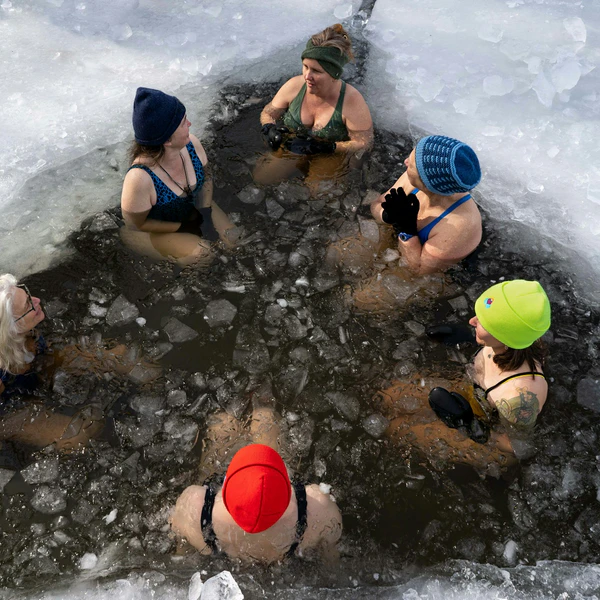
Cold plunge means you put most of your body in cold water for a short time. People do it in a tub, a barrel, a plunge unit, or a calm body of water where entry is controlled. The first sixty seconds often decide whether the session feels safe or scary.
Tipton described a cold shock response that includes fast breathing and large heart strain that can disable a person before they get close to hypothermia. (1)
Cold Shock
Cold water can trigger an involuntary gasp that pulls air in fast. Fast breathing can follow, and it can feel like panic even when nothing is wrong with your mind. Risk rises if your face goes under water during the first moments, because a gasp can pull water in.
National Weather Service guidance warns that cold water can cause cold shock and make breathing hard to control, even in strong swimmers. (2)
Breathing control is the main skill for a safer plunge. Long slow exhales help many people reduce the urge to gasp and rush air. A calm breath also helps you notice warning signs like chest tightness, lightheadedness, or a sense that you cannot settle. A plunge is not a test of grit, so ending early is often the smarter choice.
Temperature
Beginners often copy temperatures used by experienced people and then feel overwhelmed. A mild cold that lets you breathe through the first minute is safer than very cold water that forces a struggle.
Time also counts, because a short plunge can still feel strong and can still train breath control. Longer exposures increase discomfort and raise the chance you stay in for the wrong reason. Most people do better when they keep the first week short and repeatable.
A common first step is a brief cold session that ends while breathing is still calm and under control. A larger dose can come later if you still want it and your body handles it well. Habit and consistency usually beat a single hard session.
Contrast Therapy Basics
Contrast therapy means you alternate heat and cold in one session. People do it with a hot tub and a cold tub, a sauna and a cold shower, or a warm bath and a cool shower. The goal is a shift in skin temperature that you can repeat without dread. Heat often makes cold feel less shocking, so many people find contrast easier to stick with over time.
Heat Changes The Experience
Heat raises skin temperature and often makes muscles feel loose. Warmth can also make entry into cold feel less abrupt because the body starts from a comfortable place. A contrast session still needs care, because you can overheat and then feel faint when you stand up. Dizziness is a stop sign, not a challenge to push through.
Heat can also change what you want from the session. Many people use contrast to relax after hard days or to ease stiffness before bed. A cold plunge can do that for some people, yet the early stress response can also keep some people wired. The heat stage often shifts the whole session toward comfort and calm.
Simple Contrast Cycles
Many published studies use contrast water therapy protocols that vary a lot in time and temperature. A systematic review of contrast water therapy for exercise related muscle damage included trials with high risk of bias and found only modest average benefits across outcomes. (3)
A session that feels good and supports sleep can still be useful, even when the average study effect is small.
A beginner contrast session can stay simple. Start with a warm stage long enough to feel loose, then use a brief cold stage that you can handle without gasping. Repeat a few rounds and stop before you feel drained. People often do best when they treat contrast as recovery time, not as a contest.
Training Goals
Cold and contrast both change how you feel, yet training gains depend on repeated signals over weeks. Timing decides whether cold helps your next session or reduces the training signal you want. People often focus on soreness, yet soreness is not the same as progress.
Better Endurance Readiness
Endurance athletes often use cold water after hard sessions in heat. Cooling can reduce heat strain and can help you feel ready to train again soon. Contrast can also help during heavy weeks because heat can loosen stiff tissue and cold can reduce the heavy tired feeling in the legs.
A contrast routine can also suit travel and busy schedules. A warm shower and a short cool rinse can be easier than finding a full plunge setup. A routine that you repeat three times a week often helps more than a routine you do once a month. Consistency gives you the clearest signal about what helps you.
Strength Or Muscle
Cold right after lifting can clash with muscle building. Roberts and colleagues compared cold water immersion with active recovery during a strength training program and found cold reduced some acute anabolic signaling and reduced some longer term changes from training. (4)
A systematic review with meta analysis also reported that regular cold water immersion can reduce resistance training adaptation while not clearly harming aerobic performance. (5)
Many people still want cold for mood or stress reasons, so separation is the practical fix. Use cold on rest days, use it after endurance work, or place it later in the day after lifting. Contrast can also fit because you can keep the cold stage very brief.
Choosing A Method By Goal
Cold plunge fits goals that depend on a sharp short stress signal. People often use it for alertness, heat relief, and mental tolerance for discomfort. Contrast therapy fits goals that depend on relaxation and repeatable recovery work. People often use it for stiffness, soreness, and winding down after hard days.
The best method is the one you can do safely without turning it into a struggle. Safety means you can control breathing, you can get out fast, and you do not feel faint afterward. Performance means you place the session where it supports training instead of dulling it.
Safety & Red Flags
Cold exposure can stress the heart and lungs within seconds. Sudden immersion can raise heart rate and blood pressure and can also create competing nervous system signals that some researchers describe as a risk for dangerous rhythm problems in some settings. (6)
Risk also rises when people combine cold water with alcohol, risky breath holding, or unsupervised open water. American Heart Association guidance warns that cold water immersion can be risky, especially for people with heart disease. (7)
Who Should Get Medical Clearance
People with known heart disease should get medical guidance before cold plunge sessions. People with uncontrolled high blood pressure should also ask for help, because sudden cold can push blood pressure up fast.
People with a history of fainting should treat both heat and cold as higher risk. Pregnancy also deserves extra caution because extreme temperature stress is not a neutral input.
People with asthma that flares with cold air should also take care. Cold water can change breathing patterns and can trigger coughing in some people. People with seizure disorders should avoid experimenting alone. A simple safer step for many higher risk groups is cool showers rather than full immersion.
Practical Safety Rules
Entry should be controlled, not a jump or a fall. Head submersion is a choice, not a requirement, and skipping it reduces risk from gasping. A first session should happen with another person nearby and a clear exit path. Warm up afterward should be steady and gentle, because sudden intense heat can cause dizziness.
- Stop if you feel chest pain, strong shortness of breath, or a racing heart that does not settle.
- Stop if you feel faint or confused.
- Stop if you cannot control breathing after the first minute.
The goal is a repeatable practice that supports life, not a hard session that drains you.
For any health concerns or questions about a medical condition, get guidance from a physician or another appropriately trained clinician. Before changing your diet, supplements or health routine, talk with a licensed healthcare professional.
Research
Tipton, M.J. (1989) The initial responses to cold water immersion in man. Clinical Science, 77(6), pp. 581–588. Available at: https://pubmed.ncbi.nlm.nih.gov/2691172/ (Accessed: 28 April 2026).
National Weather Service (n.d.) Cold water hazards and safety. Available at: https://www.weather.gov/safety/coldwater (Accessed: 28 April 2026).
Bieuzen, F., Bleakley, C.M. and Costello, J.T. (2013) Contrast water therapy and exercise induced muscle damage. A systematic review and meta analysis. PLOS ONE, 8(4), e62356. Available at: https://pmc.ncbi.nlm.nih.gov/articles/PMC3633882/ (Accessed: 28 April 2026).
Roberts, L.A., Raastad, T., Markworth, J.F., Figueiredo, V.C., Egner, I.M., Shield, A. et al. (2015) Post exercise cold water immersion attenuates acute anabolic signalling and long term adaptations in muscle to strength training. The Journal of Physiology, 593(18), pp. 4285–4301. Available at: https://pmc.ncbi.nlm.nih.gov/articles/PMC4594298/ (Accessed: 28 April 2026).
Malta, E.S., Dutra, Y.M., Broatch, J.R., Bishop, D.J. and Zagatto, A.M. (2021) The effects of regular cold water immersion use on training induced changes in strength and endurance performance. A systematic review with meta analysis. Sports Medicine, 51(1), pp. 161–174. Available at: https://pubmed.ncbi.nlm.nih.gov/33146851/ (Accessed: 28 April 2026).
Shattock, M.J. and Tipton, M.J. (2012) Autonomic conflict. A different way to die during cold water immersion. The Journal of Physiology, 590(14), pp. 3219–3230. Available at: https://pmc.ncbi.nlm.nih.gov/articles/PMC3459038/ (Accessed: 28 April 2026).
American Heart Association (2022) You are not a polar bear. The plunge into cold water comes with risks. Available at: https://www.heart.org/en/news/2022/12/09/youre-not-a-polar-bear-the-plunge-into-cold-water-comes-with-risks (Accessed: 28 April 2026).
Cain, T., Brinsley, J., Bennett, H., Nelson, M., Maher, C. and Singh, B. (2025) Effects of cold water immersion on health and wellbeing A systematic review and meta analysis. PLOS ONE, 20(1), e0317615. doi:10.1371/journal.pone.0317615.
Zhu, Y.Z., Yang, L., Liu, T., Yao, F., Wang, Q. and Zheng, Z.Y. (2026) Effects of cold water immersion at different body regions on post exercise muscle damage recovery A systematic review and meta analysis. Frontiers in Sports and Active Living, 8, 1738075. doi:10.3389/fspor.2026.1738075.
Hohenauer, E., Taeymans, J., Baeyens, J P., Clarys, P. and Clijsen, R. (2015) The effect of post exercise cryotherapy on recovery characteristics A systematic review and meta analysis. PLOS ONE, 10(9), e0139028. doi:10.1371/journal.pone.0139028.
Leeder, J., Gissane, C., van Someren, K., Gregson, W. and Howatson, G. (2012) Cold water immersion and recovery from strenuous exercise A meta analysis. British Journal of Sports Medicine, 46(4), pp. 233–240. doi:10.1136/bjsports-2011-090061.
Piñero, A., Burke, R., Augustin, F., Mohan, A.E., DeJesus, K., Sapuppo, M. et al. (2024) Throwing cold water on muscle growth A systematic review with meta analysis of the effects of postexercise cold water immersion on resistance training adaptations. European Journal of Sport Science. doi:10.1002/ejsc.12074.
Sellwood, K.L., Brukner, P., Williams, D., Nicol, A. and Hinman, R. (2007) Ice water immersion and delayed onset muscle soreness A randomised controlled trial. British Journal of Sports Medicine, 41(6), pp. 392–397. doi:10.1136/bjsm.2006.033985.
Broatch, J.R., Petersen, A. and Bishop, D.J. (2014) Postexercise cold water immersion benefits are not greater than the placebo effect. Medicine and Science in Sports and Exercise, 46(11), pp. 2139–2147.
Versey, N.G., Halson, S.L. and Dawson, B.T. (2012) Effect of contrast water therapy duration on recovery of running performance. International Journal of Sports Physiology and Performance, 7(2), pp. 130–140.
Vaile, J.M., Gill, N.D. and Blazevich, A.J. (2007) The effect of contrast water therapy on symptoms of delayed onset muscle soreness. Journal of Strength and Conditioning Research, 21(2), pp. 697–702.
De Paula, F., Escobar, K., Bertuzzi, R., de Castro Magalhães, F., de Oliveira, D.B., Viana, R.B. et al. (2018) Post exercise cold water immersion improves the performance in a subsequent 5 km running trial. Temperature, 5(4), pp. 359–370. doi:10.1080/23328940.2018.1495023.
Gregson, W., Black, M.A., Jones, H., Milson, J., Morton, J., Dawson, B. et al. (2011) Influence of cold water immersion on limb and cutaneous blood flow at rest. The American Journal of Sports Medicine, 39(6), pp. 1316–1323. doi:10.1177/0363546510395497.
Harvard Health Publishing (year not provided) Cold plunges Healthy or harmful for your heart. Available at: https://www.health.harvard.edu/heart-health/cold-plunges-healthy-or-harmful-for-your-heart.