Key Takeaways
- Toothpaste should clean teeth without harsh grit, strong foam or unclear chemical coatings.
- Hydroxyapatite toothpaste is a strong natural choice for people avoiding fluoride.
- Fluoride toothpaste can reduce cavities, but swallowing it raises more concern for children.
- Charcoal toothpaste can be too harsh and has weak proof for real benefit.
- SLS free toothpaste may help people whose mouths get sore from regular toothpaste.
Toothpaste Basics
Toothpaste Has One Job
Toothpaste should help remove plaque, lower acid damage and support clean teeth without irritating the mouth. Plaque is the soft film that forms on teeth each day. Brushing removes most of it, while toothpaste adds mild grit, minerals, taste and foam.
A major Cochrane review found that fluoride toothpaste reduced tooth decay more than toothpaste without fluoride, with stronger effects at common adult strength levels around 1000 to 1500 ppm fluoride (1).
Ingredient List
A basic toothpaste does not need a long ingredient list. Most products contain a mild abrasive, water, a thickener, flavor, a foaming agent and an active mineral. Some also add sweet taste, color, whitening agents, tartar agents and preservatives.
The cleaner choice is usually the plainer choice. Look for a paste that names the active mineral clearly and avoids strong color, heavy flavor and harsh whitening claims. Teeth need steady cleaning more than a product that feels intense in the mouth.
Mineral Choices
Hydroxyapatite Option
Hydroxyapatite is the main mineral found in tooth enamel and bone. Toothpaste makers use it to help support the tooth surface after daily acid stress. It is one of the best natural leaning options for people who want to avoid fluoride but still want a mineral based toothpaste.
A double blind trial in children found that microcrystalline hydroxyapatite toothpaste was not worse than fluoride toothpaste for preventing early childhood caries over one year (2).
A later adult trial found that fluoride free hydroxyapatite toothpaste was not worse than fluoride toothpaste for preventing new cavities over eighteen months (3).
Hydroxyapatite toothpaste makes the most sense when the formula is plain. Choose a paste without harsh whitening grit, strong foam or bright dyes. A simple hydroxyapatite paste can clean well without turning brushing into a chemical load.
Fluoride Use
Fluoride is not a tooth nutrient. It is a poison when the dose gets high enough. Children swallow toothpaste easily because they do not spit well. A review in children under six found that swallowing pea size amounts or more can raise the risk of mild fluorosis, which can leave white marks on developing teeth (4).
Fluoride can come from toothpaste, tap water, drinks made with tap water and dental products. Those sources can stack up each day.
The National Toxicology Program reported moderate confidence that higher fluoride exposure is linked with lower IQ in children, especially at drinking water levels above 1.5 milligrams per liter (9).
A 2025 systematic review and meta analysis also found that higher fluoride exposure was linked with lower IQ scores in children (10). A plain hydroxyapatite toothpaste removes that fluoride burden while still giving the tooth surface a mineral based option. A hydroxyapatite paste is a reasonable option for families that want to avoid this issue.
Remineralizing Claims
Remineralizing is a big word for helping the tooth surface regain minerals after acid has pulled some out. The word can be overused on labels.
A 2021 meta analysis found that hydroxyapatite products showed caries protection in the clinical evidence reviewed, though the authors noted that the number of stronger trials was still limited (6).
Ingredients To Avoid
Harsh Foam
Sodium lauryl sulfate, often called SLS, makes toothpaste foam hard. Foam can make the mouth feel clean, but foam does not equal better brushing. For some people, SLS can irritate the mouth.
A systematic review found that SLS free toothpaste did not clearly reduce how often mouth ulcers appeared, but it did reduce ulcer length and pain in people with recurrent aphthous ulcers (7).
A low foam paste can feel strange at first. It still works if brushing is slow and complete. Clean teeth come from contact with the brush, contact with the tooth surface and enough time at the gum line.
Charcoal Pastes
Charcoal toothpaste sounds natural, but natural does not always mean gentle. Many charcoal pastes rely on stain scraping and dark marketing claims. A review in the Journal of the American Dental Association found too little clinical evidence to support the safety and benefit claims made for charcoal toothpastes (8).
Charcoal also makes it harder to see bleeding or gum irritation during brushing. A paste can feel fresh while still being too rough for daily use. People with thin enamel, gum recession or sensitive teeth should be careful with charcoal products.
Whitening Pastes
Whitening toothpaste often works by polishing away surface stain. It does not rebuild enamel or change the deep color of the tooth in the way many ads imply. If a paste feels gritty, burns the mouth or makes teeth more sensitive, stop using it.
A plain toothpaste and a soft brush are better daily tools than a harsh whitening paste. Teeth are not meant to be scrubbed like tile. The enamel surface is hard, but the gum edge and exposed root surface are easier to irritate.
Natural Toothpaste Choice
Better Label Check
Start with the active mineral. Hydroxyapatite is the cleaner natural leaning choice. Next check the foam. Choose SLS free if your mouth gets sore, dry or irritated from regular toothpaste. Then check the grit.
Avoid charcoal, heavy whitening pastes and anything that feels sandy. Flavor should be mild. A strong burn is not a sign of clean teeth. It is often just strong mint, alcohol like flavor or other irritants hitting the mouth lining.
Daily Use
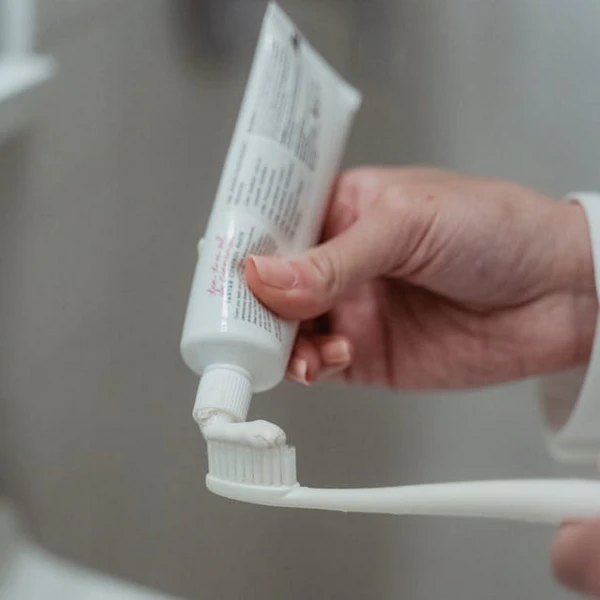
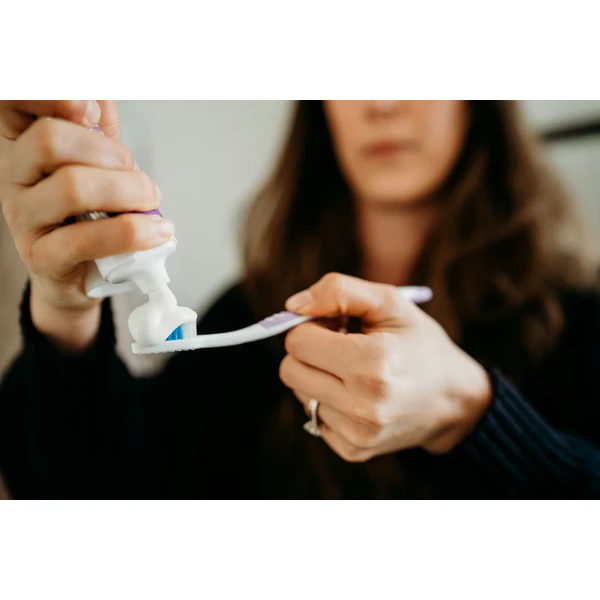
Use a soft brush and light pressure. Brush along the gum line because plaque builds there first. Hard scrubbing can wear the gum edge and make teeth more sensitive. Spit out the paste after brushing. Do not swallow toothpaste. Children need help until they can use the right amount and spit it out well.
Brush at least twice daily if your mouth handles it. Clean between teeth once daily with floss, small brushes or a water flosser. Toothpaste helps, but it cannot replace cleaning the spaces that a brush cannot reach.
For any health concerns or questions about a medical condition, get guidance from a physician or another appropriately trained clinician. Before changing your diet, supplements or health routine, talk with a licensed healthcare professional.
Research
Walsh, T. et al. 2019. Fluoride toothpastes of different concentrations for preventing dental caries. Cochrane Database of Systematic Reviews. DOI 10.1002/14651858.CD007868.pub3. PMID 30829399.
Paszynska, E. et al. 2021. Impact of a toothpaste with microcrystalline hydroxyapatite on the occurrence of early childhood caries, a 1 year randomized clinical trial. Scientific Reports. DOI 10.1038/s41598 021 81112 y. PMID 33536427.
Paszynska, E. et al. 2023. Caries preventing effect of a hydroxyapatite toothpaste in adults, a 18 month double blinded randomized clinical trial. Frontiers in Public Health. DOI 10.3389/fpubh.2023.1199728. PMID 37435947.
Saad, H. et al. 2022. Fluoride intake through dental care products, a systematic review. International Journal of Environmental Research and Public Health. DOI 10.3390/ijerph19127473. PMID 35742751.
Wright, J.T. et al. 2014. Fluoride toothpaste efficacy and safety in children younger than 6 years, a systematic review. Journal of the American Dental Association. DOI 10.14219/jada.2014.37. PMID 24929594.
Limeback, H. et al. 2021. Biomimetic hydroxyapatite and caries prevention, a systematic review and meta analysis. Canadian Journal of Dental Hygiene. PMID 34925515.
Alli, B.Y. et al. 2019. Effect of sodium lauryl sulfate on recurrent aphthous stomatitis, a systematic review. Journal of Oral Pathology & Medicine. DOI 10.1111/jop.12845. PMID 30839136.
Brooks, J.K. et al. 2017. Charcoal and charcoal based dentifrices, a literature review. Journal of the American Dental Association. DOI 10.1016/j.adaj.2017.05.001. PMID 28599961.
Hooper, S., West, N.X., Pickles, M.J., Joiner, A. and Newcombe, R.G. (2003) ‘Investigation of erosion and abrasion on enamel and dentine: a model in situ using toothpastes of different abrasivity’, Journal of Clinical Periodontology, 30(9), pp. 802–808. Available at: https://pubmed.ncbi.nlm.nih.gov/12956656/
Turssi, C.P., Hara, A.T., de Magalhães, C.S. and Serra, M.C. (2004) ‘An in situ investigation into the abrasion of eroded dental hard tissues by a whitening dentifrice’, Caries Research, 38(5), pp. 473–477. Available at: https://pubmed.ncbi.nlm.nih.gov/15316192/
Joiner, A., Philpotts, C.J., Cox, T.F., Joiner, A. and Huber, K. (2008) ‘The protective nature of pellicle towards toothpaste abrasion on enamel and dentine’, Journal of Dentistry, 36(5), pp. 360–368. Available at: https://pubmed.ncbi.nlm.nih.gov/18308449/
Haraszthy, V.I., Raylae, C.C. and Sreenivasan, P.K. (2019) ‘Antimicrobial effects of a stannous fluoride toothpaste in distinct oral microenvironments’, Journal of the American Dental Association, 150(4S), pp. S14–S24. Available at: https://pubmed.ncbi.nlm.nih.gov/30797255/
Addy, M. and Hunter, M.L. (2003) ‘Can tooth brushing damage your health? Effects on oral and dental tissues’, International Dental Journal, 53(Suppl 3), pp. 177–186. Available at: https://pubmed.ncbi.nlm.nih.gov/12875306/
Addy, M. (2005) ‘Tooth brushing, tooth wear and dentine hypersensitivity–are they associated?’, International Dental Journal, 55(4 Suppl 1), pp. 261–267. Available at: https://pubmed.ncbi.nlm.nih.gov/16167604/