Key Takeaways
- Bee pollen is a bee collected food with a varied nutrient mix.
- It offers small amounts of protein, minerals and plant compounds.
- Most research on health uses involves extracts, not plain granules.
- Allergy risk deserves more attention than marketing claims usually give.
- Small servings with real meals make more sense than heavy use.
Bee Pollen Basics
What is It
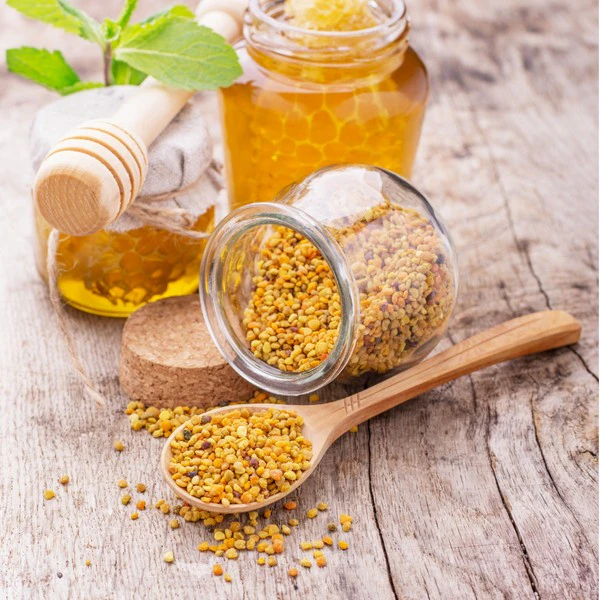
Bee pollen is a mix of flower pollen, nectar and bee secretions packed into small granules. Bees collect it from flowering plants and carry it back to the hive as food.
Reviews describe it as a complex natural material rather than a single uniform ingredient because its makeup shifts with season, soil and plant source (1, 2).
That variation explains why one jar can taste sweet and mild while another tastes earthy and bitter. Color can range from pale yellow to deep orange or brown.
Granule size also changes from batch to batch, which makes shopping by label alone less useful than many people expect.
Why People Use It
People usually reach for bee pollen because they want a compact whole food that feels more nutrient rich than ordinary sweeteners or snack toppings.
Interest often centers on energy, recovery and general daily nutrition. Reviews also note a long history of traditional use, though tradition alone does not prove a specific health effect in modern use (1, 4).
Bee pollen can add variety to meals, but no small spoonful can make up for a poor diet, low sleep or constant grazing on processed food.
What It Is Not
Bee pollen is not the same thing as honey, bee bread or royal jelly. Honey is mostly a sweet bee made food from nectar.
Bee bread is fermented pollen stored in the hive. Royal jelly is a different secretion fed to larvae and queen bees.
Studies often use different bee products and different extracts. Claims can drift when marketers blur those lines and treat every bee product as though it works the same way.
Bee Pollen Nutrition
Main Nutrients
Bee pollen contains carbohydrate, fat and protein along with a spread of minerals, vitamins and other natural compounds.
Reviews commonly list amino acids, potassium, magnesium, calcium and small amounts of B vitamins among the nutrients found in many samples, though exact levels vary a lot by floral source (1, 3).
Protein content often gets attention because bee pollen is richer in protein than many sweet toppings.
Most people eat very small servings, so the actual protein delivered at one meal is modest. A teaspoon can add nutrition, but it does not replace eggs, meat or other substantial foods.
Plant Compounds
Much of the interest around bee pollen comes from flavonoids, phenolic acids and related compounds that act as antioxidants in laboratory work.
Antioxidants are substances that can help limit certain forms of cell damage under specific conditions.
Recent reviews describe bee pollen as a source of these compounds, with possible anti inflammatory and antimicrobial activity seen in lab and animal work (3, 4).
Those findings are worth knowing, but they should stay in proportion. Lab effects do not automatically carry over to daily use in humans.
Human studies are fewer, smaller and less consistent than the marketing language suggests.
Digestibility Issues
Bee pollen has a tough outer wall that can limit how much of the inner content becomes available during digestion.
Researchers have paid close attention to this because wall disruption may improve access to nutrients and plant compounds.
Some products are sold as ground powders, soaked granules or extracts instead of whole dry pellets (3).
Chewing the granules well, soaking them into kefir or yogurt or mixing them into a moist food may be more sensible than swallowing them quickly by the spoon.
Animal Foods Supply Dense Nutrients
Only Animal foods supply B12, retinol, carnosine, creatine and taurine along with other vitamins and minerals in usable forms.
Everyday Uses
How To Start
A small serving is the safest way to begin. A few granules or one quarter teaspoon with a meal gives your body a chance to respond before you use more.
People who tolerate it well can slowly move to one half teaspoon or one teaspoon.
Bee pollen works best with real food. Stirring it into full fat yogurt, kefir or a small bowl of fruit with cream is gentler than taking a large dry spoonful on an empty stomach.
One or two meals a day with enough protein and animal fat will do more for steady energy than chasing quick boosts from tiny add ons.
Simple Meal Ideas
Two easy uses fit most routines.
- Stir a small amount into plain kefir or full fat yogurt and eat it with breakfast.
- Sprinkle a light layer over cottage cheese, soft fruit or a simple smoothie.
A small amount can also be mixed into raw honey for taste, though that adds sweetness without adding much protein.
What Research Supports
The strongest human evidence around pollen tends to involve specific extracts used for defined symptoms, not ordinary raw granules sold as a general superfood.
An umbrella review found some signal for uses such as menopausal symptoms, prostatitis and prostate related urinary symptoms, but the review also pointed out that the evidence base is limited and mixed (5).
Some trials reported symptom improvement with pollen extracts in chronic prostatitis and related pelvic pain or in menopausal hot flushes (6, 7).
Another review of clinical trials noted that most work remains narrow in scope and does not justify broad claims for every product on the shelf (8, 9).
Use vs Avoid
| Use | Avoid |
|---|---|
| Ruminant meat | Low fat processed foods |
| Eggs | Seed oils |
| Seafood | Anything Fortified |
| Organs | Carbohydrates |
Safety & Smart Use
Allergy Risk
Allergy risk is the biggest practical concern. Bee pollen can trigger reactions in people who are sensitive to pollen or other bee products.
Reactions can range from mouth itching and rash to breathing trouble in severe cases. Reviews consistently flag this as a real safety issue rather than a rare footnote (1, 8).
Caution makes sense on the first use. Try a very small amount with food and stop right away if you notice itching, swelling, hives, wheezing or stomach distress.
Who Should Be Careful
People with a history of pollen allergy, severe seasonal allergy, asthma or reactions to bee products should be especially careful.
Pregnancy, breast feeding and use in young children call for extra caution because safety data are limited.
Anyone taking anticoagulant medication also needs professional advice before using it regularly because supplement interactions are not always well studied (1, 8).
Buying & Storage
Bee pollen can vary in freshness, purity and moisture level, so buying from a producer with clear handling practices is wiser than buying the cheapest jar.
Heat, light and moisture can all reduce quality over time. Keep it sealed and cold after opening unless the label states another method.
A refrigerator works for many products. A freezer can help with longer storage. Fresh smell, dry texture and a clean label are better signs than bright marketing language.
For any health concerns or questions about a medical condition, get guidance from a physician or another appropriately trained clinician. Before changing your diet, supplements or health routine, talk with a licensed healthcare professional.
Suggested Posts

Research
Khalifa, S.A.M., Elashal, M.H., Yosri, N., Du, M., Musharraf, S.G., Nahar, L., Sarker, S.D., Guo, Z. and Cao, W. (2021) ‘Bee Pollen Current Status and Therapeutic Potential’, Nutrients, 13(6), 1876. Available at https://pmc.ncbi.nlm.nih.gov/articles/PMC8230257/
Komosinska Vassev, K., Olczyk, P., Kazmierczak, J., Mencner, L. and Olczyk, K. (2015) ‘Bee pollen chemical composition and therapeutic application’, Evidence Based Complementary and Alternative Medicine, 2015, 297425. Available at https://pmc.ncbi.nlm.nih.gov/articles/PMC4377380/
Qiao, J., Wang, Y., Zhang, W., Zhao, Y., Wang, S. and Xu, B. (2024) ‘New insights into bee pollen Nutrients, phytochemicals, functions and wall disruption’, Food Research International, 178, 113934. Available at https://pubmed.ncbi.nlm.nih.gov/38309905/
El Ghouizi, A., Bakour, M., Lyoussi, B. and da Silva, A.B. (2023) ‘Bee Pollen as Functional Food Insights into Its Composition and Therapeutic Properties’, Antioxidants, 12(3), 557. Available at https://www.mdpi.com/2076-3921/12/3/557
Antonelli, M., Donelli, D., Firenzuoli, F. and Maggini, V. (2019) ‘Therapeutic efficacy of orally administered pollen for nonallergic diseases An umbrella review’, Phytotherapy Research, 33(11), pp. 2938 to 2947. Available at https://pubmed.ncbi.nlm.nih.gov/31435975/
Wagenlehner, F.M.E., Schneider, H., Ludwig, M. and Schnitker, J. (2009) ‘A pollen extract Cernilton in patients with inflammatory chronic prostatitis chronic pelvic pain syndrome a multicentre, randomised, prospective, double blind, placebo controlled phase 3 study’, European Urology, 56(3), pp. 544 to 551. Available at https://pubmed.ncbi.nlm.nih.gov/19524353/
Winther, K., Rein, E. and Hedman, C. (2005) ‘Femal, a herbal remedy made from pollen extracts, reduces hot flushes and improves quality of life in menopausal women a randomized, placebo controlled, parallel study’, Climacteric, 8(2), pp. 162 to 170. Available at https://pubmed.ncbi.nlm.nih.gov/16096172/
Algethami, J.S., Adgaba, N., Getahun, E.A. and Abdullah, A.M. (2022) ‘Bee Pollen Clinical Trials and Patent Applications’, Nutrients, 14(14), 2858. Available at https://pubmed.ncbi.nlm.nih.gov/35889814/
Wilt, T.J., Ishani, A., Mac Donald, R., Stark, G. and Mulrow, C. (2000) ‘Cernilton for benign prostatic hyperplasia’, Cochrane Database of Systematic Reviews, (2), CD001042. Available at https://pubmed.ncbi.nlm.nih.gov/10796739/
Denisow, B. and Denisow Pietrzyk, M. (2016) ‘Biological and therapeutic properties of bee pollen A review’, Journal of the Science of Food and Agriculture, 96(13), pp. 4303 to 4309. Available at https://pubmed.ncbi.nlm.nih.gov/27013064/
MacDonald, R., Wilt, T.J., Ishani, A. and Stark, G. (2000) ‘A systematic review of Cernilton for the treatment of benign prostatic hyperplasia’, BJU International, 85(7), pp. 836 to 841. Available at https://pubmed.ncbi.nlm.nih.gov/10792162/
Munstedt, K., Voss, B., Kullmer, U., Schneider, U. and Hubner, J. (2015) ‘Bee pollen and honey for the alleviation of hot flushes and other menopausal symptoms in breast cancer patients’, Molecular and Clinical Oncology, 3(4), pp. 869 to 874. Available at https://pubmed.ncbi.nlm.nih.gov/26171198/
Buck, A.C., Cox, R., Rees, R.W., Ebeling, L. and John, A. (1990) ‘Treatment of outflow tract obstruction due to benign prostatic hyperplasia with the pollen extract, Cernilton A double blind, placebo controlled study’, British Journal of Urology, 66(4), pp. 398 to 404. Available at https://pubmed.ncbi.nlm.nih.gov/1699628/
Preuss, H.G., Marcusen, C., Regan, J., Klimberg, I., Welebir, T.A. and Jones, W.A. (2001) ‘Randomized trial of a combination of natural products on symptoms of benign prostatic hyperplasia’, International Urology and Nephrology, 33(2), pp. 217 to 225. Available at https://pubmed.ncbi.nlm.nih.gov/12092634/
Qian, X., Pan, C., Xu, Z., Hao, Q. and Wang, S. (2015) ‘Therapeutic efficacy of Cernilton in benign prostatic hyperplasia patients with histological prostatitis after transurethral resection of the prostate’, International Journal of Clinical and Experimental Medicine, 8(7), pp. 11268 to 11275. Available at https://pubmed.ncbi.nlm.nih.gov/26379934/
Yasumoto, R., Kawanishi, H., Tsujino, T., Tsujita, M., Nishisaka, N. and Kishimoto, T. (1995) ‘Clinical evaluation of long term treatment using cernitin pollen extract in patients with benign prostatic hyperplasia’, Clinical Therapeutics, 17(1), pp. 82 to 87. Available at https://pubmed.ncbi.nlm.nih.gov/7538904/
Aoki, A., Ohta, K., Yokoyama, O., Namiki, M. and Sonoda, T. (2002) ‘Clinical evaluation of the effect of tamsulosin hydrochloride and cernitin pollen extract on urinary disturbance associated with benign prostatic hyperplasia in a multicentered study’, Hinyokika Kiyo, 48(5), pp. 259 to 267. Available at https://pubmed.ncbi.nlm.nih.gov/12094707/
Chen, H.J., Jin, X.H. and Wang, K.J. (2002) ‘Effects of pollen extract EA 10, P5 on chronic prostatitis or infertility with chronic prostatitis’, Acta Pharmacologica Sinica, 23(11), pp. 1035 to 1039. Available at https://pubmed.ncbi.nlm.nih.gov/12421482/
Shaplygin, L.V. and Sivakov, A.A. (2007) ‘Use of Cernilton in the therapy of prostatic adenoma and chronic prostatitis’, Urologiia, (3), pp. 35 to 39. Available at https://pubmed.ncbi.nlm.nih.gov/17722618/
Buck, A.C., Rees, R.W. and Ebeling, L. (1989) ‘Treatment of chronic prostatitis and prostatodynia with pollen extract’, British Journal of Urology, 64(5), pp. 496 to 499. Available at https://pubmed.ncbi.nlm.nih.gov/2692777/