Key Takeaways
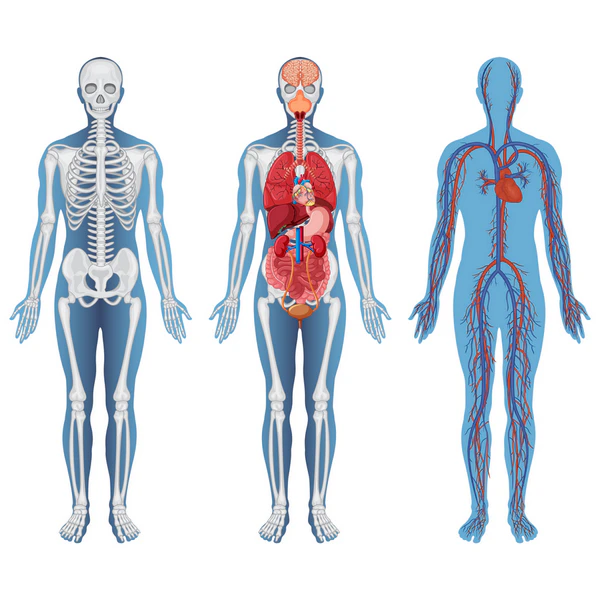
- The body uses linked systems to keep cells alive and stable.
- Nerves and hormones help organs act at the right time.
- Blood moves oxygen, fuel, heat, and waste through the body.
- The gut, kidneys, lungs, and skin help keep balance steady.
- Bones, muscles, skin, and immune cells protect daily life.
Body Balance
Homeostasis
The human body is built to keep its inner state steady while the outside world keeps changing. This steady state is called homeostasis, which means balance inside the body.
Body heat, blood pressure, water level, salt level, and blood sugar all need to stay in a safe range for cells to work well.
No one organ can do this alone. The brain reads signals from nerves and blood. The heart and blood vessels shift flow where it is needed most.
The lungs bring in oxygen and remove carbon dioxide. The kidneys fine tune water, salts, and acid balance.
The skin helps with heat loss and keeps the body sealed from the outside world (Benarroch, 2020; Koeppen, 2009; McLafferty et al., 2012).
Levels Of Organization
The body is arranged in layers. Cells are the smallest living units. Groups of like cells form tissues. Tissues build organs. Organs work in organ systems. Those systems then work as one whole person.
This order helps explain why body problems rarely stay in one place. A change in one tissue can spread to an organ, then to a full system.
A low blood flow state, for example, can affect the brain, kidneys, gut, and muscles at the same time.
Physiology is the study of how these parts work, while anatomy is the study of what those parts look like.
Control & Transport
Nervous System
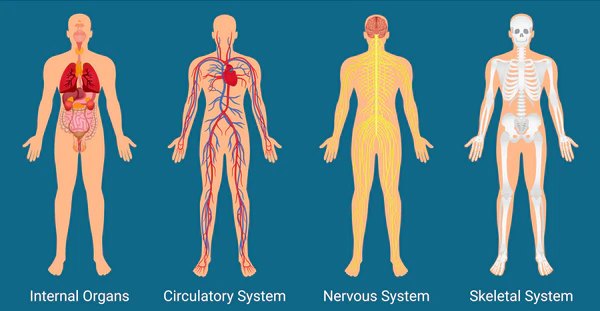
The nervous system sends fast signals. It uses the brain, spinal cord, and nerves to sense the world, guide motion, and control many body tasks without conscious thought.
One key part is the autonomic nervous system. This is the branch that runs heart rate, blood vessel tone, gut movement, sweating, and pupil size.
It has two main arms. The sympathetic arm helps the body meet stress and effort. The parasympathetic arm helps rest, digestion, and repair (Benarroch, 2020; Murtazina and Adameyko, 2023).
Endocrine System
The endocrine system sends slower signals through hormones. Hormones are chemical messengers made by glands and released into blood.
They help direct growth, sleep rhythms, salt and water control, stress response, body heat, and sex function.
This system works closely with the nervous system. The brain can start hormone release, and hormones can then change how organs act for minutes, hours, or even days.
That makes the endocrine system useful for longer jobs, while nerves handle second to second change (Hiller-Sturmhöfel and Bartke, 1998; van den Beld et al., 2018).
Cardiovascular & Respiratory Systems
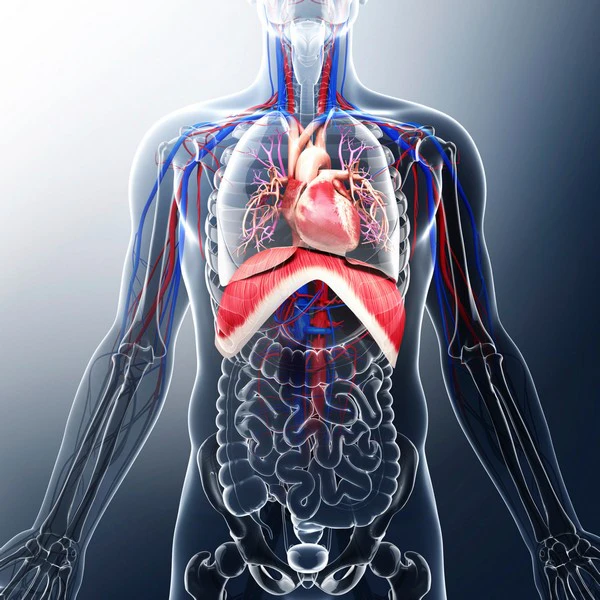
The heart and blood vessels move blood through the body. Blood carries oxygen from the lungs, fuel from the gut, hormones from glands, heat from deep tissues, and waste toward organs that remove it.
The heart acts as a pump, while blood vessels direct flow and help control pressure (Gavaghan, 1998; Rowell, 1974).
The lungs work with that system every moment. Air moves into tiny air sacs, where oxygen enters blood and carbon dioxide leaves it.
Breathing rate and depth change with sleep, speech, exercise, fever, fear, and disease.
Good gas exchange depends on both healthy lungs and steady blood flow through them (Kaminsky et al., 2023; González-Alonso, 2012).
Body Systems Work Through Feedback
Temperature, pressure, blood sugar and fluid balance change through feedback loops.
Fuel And Waste
Digestive System
The digestive system takes food and drink, breaks them down, absorbs useful parts, and moves the rest out as waste.
The mouth, stomach, small bowel, large bowel, liver, gallbladder, and pancreas all help with this work.
Digestion is not just about breaking food apart. It also depends on timing, enzymes, fluids, nerves, and blood supply.
The gut also has close ties to the brain and immune system. Gut nerves help control movement and secretion. Immune cells line the gut wall and watch what comes through.
When this system works well, the body can draw in fuel, water, minerals, and amino acids while keeping harmful germs and toxins from crossing too easily (Greenwood-Van Meerveld et al., 2017; Santucci and Velez, 2024).
Urinary System
The kidneys clean blood and help keep body fluid safe. They remove waste products, balance water, guide salt levels, help control blood pressure, and keep acid and base in range.
The body makes acid during normal living, and the kidneys help remove that acid while saving useful bicarbonate, which helps stop blood from becoming too acidic (Koeppen, 2009).
The kidneys also protect themselves by adjusting blood flow across a wide range of pressure. This process is called autoregulation.
It helps keep filtration stable, which is vital because too little filtration can let waste build up, while too much pressure can harm delicate kidney tissue (Loutzenhiser et al., 2006).
Check vs Skip
| Check | Skip |
|---|---|
| Sleep | Single cause claims |
| Minerals | Random supplements |
| Food intake | Poor sleep |
| Stress load | Ignoring symptoms |
Support And Defense
Musculoskeletal System
The musculoskeletal system gives the body shape, support, and movement. Bones form a strong frame, store minerals, and protect organs like the brain, heart, and lungs.
Muscles pull on bones to create motion, hold posture, and make heat.
Skeletal muscle is made of long fibers that shorten when told to do so by nerves. That pulling action lets a person walk, lift, speak, chew, breathe, and keep balance.
Muscle also helps manage blood sugar and energy use, while bone keeps changing through life in response to load, age, and hormones (Frontera and Ochala, 2015; Boros and Freemont, 2017).
Skin & Immune System
The skin is the body’s outer shield. It blocks water loss, helps control heat, senses touch, and gives a first layer of defense against injury and germs.
Hair, nails, sweat glands, and oil glands all support that work. Skin also helps the body react to heat by changing blood flow and sweat output (McLafferty et al., 2012).
The immune system works across the whole body rather than in one spot. It uses white blood cells, antibodies, chemical signals, lymph nodes, spleen, bone marrow, and barrier tissues to detect and remove threats.
Part of this defense acts fast and broadly. Another part learns from past exposure and responds with more precision the next time (Parkin and Cohen, 2001; Chaplin, 2010).
Reproductive System
The reproductive system supports sex hormone production, sexual function, and the ability to have children.
In females, the ovaries, uterus, and related hormones guide ovulation, the monthly cycle, and pregnancy support. In males, the testes and related ducts support sperm production and sex hormone release.
This system is tied closely to the brain and endocrine system. Hormone signals rise and fall in rhythms, and those rhythms can change with age, sleep, stress, body fat, and illness (Bates and Bowling, 2013; Hiller-Sturmhöfel and Bartke, 1998).
Before changing your diet, supplements, or health routine, talk with a licensed healthcare professional. For any health concerns or questions about a medical condition, get guidance from a physician or another appropriately trained clinician.
Suggested Posts
Evidence Limits
Research
Benarroch, E.E. 2020, ‘Physiology and Pathophysiology of the Autonomic Nervous System’, Continuum (Minneap Minn), vol. 26, no. 1, pp. 12-24. Available at: https://pubmed.ncbi.nlm.nih.gov/31996619/
Koeppen, B.M. 2009, ‘The kidney and acid-base regulation’, Advances in Physiology Education, vol. 33, no. 4, pp. 275-281. Available at: https://pubmed.ncbi.nlm.nih.gov/19948674/
McLafferty, E., Hendry, C. and Farley, A. 2012, ‘The integumentary system: anatomy, physiology and function of skin’, Nursing Standard, vol. 27, no. 3, pp. 35-42. Available at: https://pubmed.ncbi.nlm.nih.gov/23248884/
Murtazina, A. and Adameyko, I. 2023, ‘The peripheral nervous system’, Development, vol. 150, no. 10. Available at: https://pubmed.ncbi.nlm.nih.gov/37170957/
Hiller-Sturmhöfel, S. and Bartke, A. 1998, ‘The endocrine system: an overview’, Alcohol Health and Research World, vol. 22, no. 3, pp. 153-164. Available at: https://pubmed.ncbi.nlm.nih.gov/15706790/
van den Beld, A.W., Kaufman, J.M., Zillikens, M.C., Lamberts, S.W.J., Egan, J.M. and van der Lely, A.J. 2018, ‘The physiology of endocrine systems with ageing’, The Lancet Diabetes & Endocrinology, vol. 6, no. 8, pp. 647-658. Available at: https://pubmed.ncbi.nlm.nih.gov/30017799/
Gavaghan, M. 1998, ‘Cardiac anatomy and physiology: a review’, AORN Journal, vol. 67, no. 4, pp. 802-822. Available at: https://pubmed.ncbi.nlm.nih.gov/9561274/
Rowell, L.B. 1974, ‘Human cardiovascular adjustments to exercise and thermal stress’, Physiological Reviews, vol. 54, no. 1, pp. 75-159. Available at: https://pubmed.ncbi.nlm.nih.gov/4587247/
Kaminsky, D.A., Simpson, S.Q. and Basner, R.C. 2023, ‘Review of Pulmonary Physiology’, Seminars in Respiratory and Critical Care Medicine, vol. 44, no. 5, pp. 509-510. Available at: https://pubmed.ncbi.nlm.nih.gov/37816343/
González-Alonso, J. 2012, ‘Human thermoregulation and the cardiovascular system’, Experimental Physiology, vol. 97, no. 3, pp. 340-346. Available at: https://pubmed.ncbi.nlm.nih.gov/22227198/
Greenwood-Van Meerveld, B., Johnson, A.C. and Grundy, D. 2017, ‘Gastrointestinal Physiology and Function’, Handbook of Experimental Pharmacology, vol. 239, pp. 1-16. Available at: https://pubmed.ncbi.nlm.nih.gov/28176047/
Santucci, N.R. and Velez, A. 2024, ‘Physiology of lower gastrointestinal tract’, Alimentary Pharmacology & Therapeutics, vol. 60, suppl. 1, pp. S1-S19. Available at: https://pubmed.ncbi.nlm.nih.gov/38924125/
Loutzenhiser, R., Bidani, A. and Chilton, L. 2006, ‘Renal autoregulation: new perspectives regarding the protective and regulatory roles of the underlying mechanisms’, American Journal of Physiology-Regulatory, Integrative and Comparative Physiology, vol. 290, no. 5, pp. R1153-R1167. Available at: https://pubmed.ncbi.nlm.nih.gov/16603656/
Frontera, W.R. and Ochala, J. 2015, ‘Skeletal muscle: a brief review of structure and function’, Calcified Tissue International, vol. 96, no. 3, pp. 183-195. Available at: https://pubmed.ncbi.nlm.nih.gov/25294644/
Boros, K. and Freemont, T. 2017, ‘Physiology of ageing of the musculoskeletal system’, Best Practice & Research Clinical Rheumatology, vol. 31, no. 2, pp. 203-217. Available at: https://pubmed.ncbi.nlm.nih.gov/29224697/
Parkin, J. and Cohen, B. 2001, ‘An overview of the immune system’, The Lancet, vol. 357, no. 9270, pp. 1777-1789. Available at: https://pubmed.ncbi.nlm.nih.gov/11403834/
Chaplin, D.D. 2010, ‘Overview of the immune response’, Journal of Allergy and Clinical Immunology, vol. 125, no. 2 Suppl 2, pp. S3-S23. Available at: https://pubmed.ncbi.nlm.nih.gov/20176265/
Bates, G.W. and Bowling, M. 2013, ‘Physiology of the female reproductive axis’, Periodontology 2000, vol. 61, no. 1, pp. 89-102. Available at: https://pubmed.ncbi.nlm.nih.gov/23240945/
McComb, S., Thiriot, A., Akache, B., Krishnan, L. and Stark, F. 2019, ‘Introduction to the Immune System’, Methods in Molecular Biology, vol. 2024, pp. 1-24. Available at: https://pubmed.ncbi.nlm.nih.gov/31364040/
Frontera, W.R. 2017, ‘Physiologic Changes of the Musculoskeletal System with Aging: A Brief Review’, Physical Medicine and Rehabilitation Clinics of North America, vol. 28, no. 4, pp. 705-711. Available at: https://pubmed.ncbi.nlm.nih.gov/29031337/