
Key Takeaways
- Diabetes and high blood pressure cause most chronic kidney disease in adults.
- Treatment aims to slow damage, lower urine protein, and prevent kidney failure.
- Blood and urine tests usually find kidney disease before symptoms become obvious.
- Large carbohydrate loads can worsen diabetes control and speed kidney harm.
- Late stage disease may require dialysis, transplant planning, or both.
What CKD Means
Basic Definition
Chronic kidney disease, or CKD, means the kidneys stay damaged for at least three months, or they filter blood less well than they should.
The kidneys normally remove waste, balance fluid, and help control minerals in the blood.
When those jobs weaken over time, waste builds up, swelling can appear, and blood pressure often gets harder to control (NIDDK, 2025).
Many people feel normal during early CKD, which is why testing has such high value. Blood work estimates kidney filtering with eGFR, which stands for estimated glomerular filtration rate.
Urine testing checks for albumin, a blood protein that leaks into urine when kidney filters are hurt (NIDDK, 2025).
Why Early Care Counts
CKD often gets worse in a slow, steady way when the cause stays active. Early treatment gives the best chance to slow that slide, reduce urine protein, and delay kidney failure.
Current guidance puts heavy weight on finding the cause, checking eGFR and urine albumin over time, and treating blood pressure, diabetes, and other drivers hard and early (KDIGO, 2024; NIDDK, 2025).
Common Causes
Diabetes
Diabetes is a leading cause of CKD because high blood glucose can scar the tiny kidney filters over time. That damage lets albumin leak into urine and slowly lowers kidney function.
Good glucose control lowers the risk of albumin in urine and cuts the risk of kidney damage getting worse (NIDDK, 2025; American Diabetes Association, 2025).
Bread, rice, pasta, and desserts all raise blood glucose. For a person with diabetes or insulin resistance, large servings of those foods, eaten often, can keep glucose high for long stretches.
Eating these foods can keep pressure on already damaged kidneys.
Research on low carbohydrate eating in CKD suggests better glucose control and weight loss may help some people, though care is needed so protein intake does not climb too high in later stages (de Boer et al., 2022; Mitchell et al., 2019).
People with CKD and poor glucose control usually do better when they cut back hard on refined starches and sugary foods, rather than arguing over added sugar alone.
One large cohort study also linked a carbohydrate rich diet with higher risk of new CKD in adults without diabetes, though that kind of study cannot prove cause by itself (Nam et al., 2019).
High Blood Pressure
High blood pressure is the other major cause in adults. Pressure that stays high can damage blood vessels in the kidneys, which then weakens filtering and raises pressure even more.
That cycle can keep feeding itself for years unless it gets broken (NIDDK, 2025).
Blood pressure control slows damage better than almost anything else. KDIGO advises a target systolic blood pressure below 120 mm Hg for many adults with CKD when that target is tolerated and measured in a standard way.
Doctors also often use medicines that lower urine albumin and protect kidney filters, especially when protein leak is present (KDIGO, 2024; NIDDK, 2025).
Other Causes
Other causes include glomerulonephritis, which means inflammation of the kidney filters, inherited diseases such as polycystic kidney disease, repeated kidney infections, blocked urine flow, some autoimmune disease, and long term use of certain pain medicines like NSAIDs.
Obesity, smoking, and heart disease also raise risk and can speed progression once CKD has started (NIDDK, 2025; Chen, Knicely and Grams, 2019).
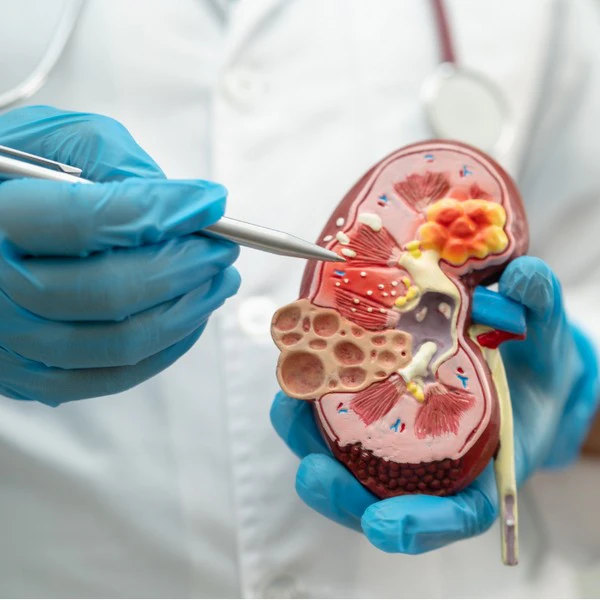
Kidney Markers Need Context
Hydration, blood pressure, blood sugar and infection risk can all affect kidney stress.
How Treatment Works
Tests
Doctors usually follow two main numbers over time. One is eGFR, which estimates filtering strength. The other is urine albumin, which shows how much protein leak is happening.
Those two tests together help stage CKD, estimate risk, and guide treatment changes (NIDDK, 2025; KDIGO, 2024).
Treatment also includes looking for anemia, bone and mineral problems, acid build up, fluid overload, and high potassium. Those issues become more common as kidney function falls.
Regular checks help catch them before they turn into urgent problems (Chen, Knicely and Grams, 2019; NIDDK, 2025).
Blood Pressure
Strong blood pressure control slows kidney decline, especially when urine protein is high. In people with diabetes, keeping blood glucose in target range also lowers the risk of more kidney damage.
That is why most treatment plans keep coming back to the same core targets, even when the drug list changes over time (NIDDK, 2025; American Diabetes Association, 2025).
Doctors may use medicines such as ACE inhibitors, ARBs, or SGLT2 inhibitors because trials show kidney benefit in many patients with protein in urine, diabetes, or both.
Those decisions depend on lab results, blood pressure, potassium, stage of CKD, and other illnesses, so they need medical follow up rather than guesswork at home (de Boer et al., 2022; Heerspink et al., 2020).
Check vs Skip
| Check | Skip |
|---|---|
| Blood pressure | Spinach |
| Blood sugar | Almonds |
| Hydration | Swiss Chard |
| UTI symptoms | Carbohydrates |
Food Changes
Carbohydrates
You do not need huge amounts of sugar to keep glucose high. Bread, rice, pasta and frequent snack foods can all convert to sugar.
For many patients, the kidney saving move is cutting total carbohydrate load, especially refined starch, not merely swapping one dessert for another (de Boer et al., 2022; Mitchell et al., 2019).
That does not mean every person with CKD should chase a very high protein diet.
KDIGO advises about 0.8 grams of protein per kilogram of body weight each day for many adults with CKD who are not on dialysis, and advises avoiding protein intakes above 1.3 grams per kilogram each day.
A lower carbohydrate plan for CKD therefore works best when extra calories come from appropriate fats and carefully chosen foods, not from pushing protein sky high (KDIGO, 2024).
Potassium & Phosphorus
Most people with CKD need less sodium because excess isolated sodium raises blood pressure and fluid retention.
KDIGO suggests staying below 2 grams of sodium each day for many adults with CKD. Packaged foods, fast food, deli meats, canned soup, sauces, and salty snacks are major sources (KDIGO, 2024).
Potassium and phosphorus are more stage dependent. Some people need to limit them, while others do not.
The safest plan comes from blood tests and a meal plan based on the person’s own labs, stage, and symptoms (NIDDK, 2025).
Kidney Risk Check
Advanced Care
Dialysis & Transplant
CKD cannot usually be reversed once scar tissue has formed, but progression can often be slowed for years.
When kidney function drops very low or symptoms become severe, dialysis or transplant planning enters the picture.
Dialysis cleans the blood when the kidneys can no longer do enough on their own.
Transplant replaces kidney function with a donor kidney and is often the preferred long term option for suitable patients (NIDDK, 2025; National Kidney Foundation, 2025).
Planning should start before an emergency develops. That gives time to choose dialysis type, discuss access surgery, check transplant options, and manage symptoms with less stress and fewer rushed decisions (Chen, Knicely and Grams, 2019).
Before changing your diet, supplements, or health routine, talk with a licensed healthcare professional. For any health concerns or questions about a medical condition, get guidance from a physician or another appropriately trained clinician.
Suggested Posts


Evidence Limits
Research
National Institute of Diabetes and Digestive and Kidney Diseases (2025) ‘Chronic Kidney Disease (CKD)’. Available at: https://www.niddk.nih.gov/
National Institute of Diabetes and Digestive and Kidney Diseases (2025) ‘Chronic Kidney Disease Tests & Diagnosis’. Available at: https://www.niddk.nih.gov/
Kidney Disease: Improving Global Outcomes (KDIGO) CKD Work Group (2024) ‘KDIGO 2024 Clinical Practice Guideline for the Evaluation and Management of Chronic Kidney Disease’, Kidney International, 105(4S), pp. S117 to S314. Available at: https://kdigo.org/
National Institute of Diabetes and Digestive and Kidney Diseases (2025) ‘Manage Patients With Chronic Kidney Disease’. Available at: https://www.niddk.nih.gov/
National Institute of Diabetes and Digestive and Kidney Diseases (2025) ‘Causes of Chronic Kidney Disease in Adults’. Available at: https://www.niddk.nih.gov/
American Diabetes Association (2025) ‘Chronic Kidney Disease (Nephropathy)’. Available at: https://diabetes.org/
de Boer, I.H. et al. (2022) ‘Diabetes management in chronic kidney disease: a consensus report by the American Diabetes Association and Kidney Disease: Improving Global Outcomes’, Kidney International, 102(5), pp. 974 to 989. Available at: https://kdigo.org/
Mitchell, N.S. et al. (2019) ‘Are low-carbohydrate diets safe in chronic or diabetic kidney disease?’, Annals of the New York Academy of Sciences, 1454(1), pp. 77 to 94. Available at: https://pmc.ncbi.nlm.nih.gov/
Nam, K.H. et al. (2019) ‘Carbohydrate-rich diet is associated with increased risk of incident chronic kidney disease in non-diabetic subjects’, BMC Nephrology, 20, 252. Available at: https://pmc.ncbi.nlm.nih.gov
Chen, T.K., Knicely, D.H. and Grams, M.E. (2019) ‘Chronic Kidney Disease Diagnosis and Management: A Review’, JAMA, 322(13), pp. 1294 to 1304. Available at: https://jamanetwork.com/
Heerspink, H.J.L. et al. (2020) ‘Dapagliflozin in Patients with Chronic Kidney Disease’, New England Journal of Medicine, 383(15), pp. 1436 to 1446. Available at: https://www.nejm.org/
Jafar, T.H. et al. (2001) ‘Angiotensin-converting enzyme inhibitors and progression of nondiabetic renal disease. A meta-analysis of patient-level data’, Annals of Internal Medicine, 135(2), pp. 73 to 87. Available at: https://www.acpjournals.org/
Perkovic, V. et al. (2019) ‘Canagliflozin and Renal Outcomes in Type 2 Diabetes and Nephropathy’, New England Journal of Medicine, 380(24), pp. 2295 to 2306. Available at: https://www.nejm.org/
National Kidney Foundation (2025) ‘Kidney Disease: Fact Sheet’. Available at: https://www.kidney.org/
Hahn, D., Hodson, E.M. and Fouque, D. (2020) ‘Low protein diets for non-diabetic adults with chronic kidney disease’, Cochrane Database of Systematic Reviews, 10(10), CD001892. doi: 10.1002/14651858.CD001892.pub5. PMID: 33118160.
Lv, J. et al. (2013) ‘Effects of intensive blood pressure lowering on the progression of chronic kidney disease: a systematic review and meta-analysis’, CMAJ, 185(11), pp. 949–957. doi: 10.1503/cmaj.121468. PMID: 23798459.
Malhotra, R. et al. (2017) ‘Association Between More Intensive vs Less Intensive Blood Pressure Lowering and Risk of Mortality in Chronic Kidney Disease Stages 3 to 5: A Systematic Review and Meta-analysis’, JAMA Internal Medicine, 177(10), pp. 1498–1505. doi: 10.1001/jamainternmed.2017.4377. PMID: 28873137.
Li, N. et al. (2021) ‘Effects of SGLT2 Inhibitors on Renal Outcomes in Patients With Chronic Kidney Disease: A Meta-Analysis’, Frontiers in Medicine, 8, 728089. doi: 10.3389/fmed.2021.728089. PMID: 34790672.
Garofalo, C. et al. (2017) ‘A systematic review and meta-analysis suggests obesity predicts onset of chronic kidney disease in the general population’, Kidney International, 91(5), pp. 1224–1235. doi: 10.1016/j.kint.2016.12.013. PMID: 28187985.
Tsai, W.-C. et al. (2016) ‘Risk Factors for Development and Progression of Chronic Kidney Disease: A Systematic Review and Exploratory Meta-Analysis’, Medicine (Baltimore), 95(11), e3013. doi: 10.1097/MD.0000000000003013. PMID: 26986114.
Tonelli, M. et al. (2006) ‘Chronic kidney disease and mortality risk: a systematic review’, Journal of the American Society of Nephrology, 17(7), pp. 2034–2047. doi: 10.1681/ASN.2005101085. PMID: 16738019.
The EMPA-KIDNEY Collaborative Group et al. (2023) ‘Empagliflozin in Patients with Chronic Kidney Disease’, New England Journal of Medicine, 388(2), pp. 117–127. doi: 10.1056/NEJMoa2204233. PMID: 36331190.
Bakris, G.L. et al. (2020) ‘Effect of Finerenone on Chronic Kidney Disease Outcomes in Type 2 Diabetes’, New England Journal of Medicine, 383(23), pp. 2219–2229. doi: 10.1056/NEJMoa2025845. PMID: 33264825.
Wright, J.T. Jr et al. (2002) ‘Effect of blood pressure lowering and antihypertensive drug class on progression of hypertensive kidney disease: results from the AASK trial’, JAMA, 288(19), pp. 2421–2431. doi: 10.1001/jama.288.19.2421. PMID: 12435255.
Brenner, B.M. et al. (2001) ‘Effects of losartan on renal and cardiovascular outcomes in patients with type 2 diabetes and nephropathy’, New England Journal of Medicine, 345(12), pp. 861–869. doi: 10.1056/NEJMoa011161. PMID: 11565518.
Lewis, E.J. et al. (2001) ‘Renoprotective effect of the angiotensin-receptor antagonist irbesartan in patients with nephropathy due to type 2 diabetes’, New England Journal of Medicine, 345(12), pp. 851–860. doi: 10.1056/NEJMoa011303. PMID: 11565517.
Agodoa, L.Y. et al. (2001) ‘Effect of ramipril vs amlodipine on renal outcomes in hypertensive nephrosclerosis: a randomized controlled trial’, JAMA, 285(21), pp. 2719–2728. doi: 10.1001/jama.285.21.2719. PMID: 11386927.