Key Takeaways
- Butter is a traditional dairy fat made from cream through a short old process.
- Large reviews do not give a clean case against butter or dairy fat.
- Old seed oil swap trials did not show the promised survival benefit.
- Cholesterol changes alone cannot prove that a fat swap improves real health.
- Butter works best with real food instead of refined oils or processed food.
Butter As Traditional Fat
Cream To Butter
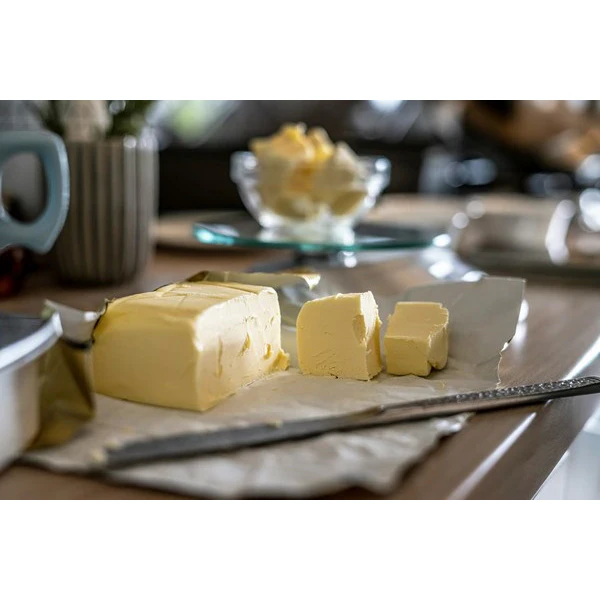
Butter starts as cream. Cream comes from milk, then churning brings the fat together into a solid dairy fat.
People used butter long before factory spreads, refined seed oils, food gums, bleaching steps or lab made fat blends entered the food supply.
Traditional butter has a short path from milk to food. Cream is separated, churned and worked until water and fat settle into their familiar form.
Good butter needs very little help. Salt may be added, but the main food is still dairy fat from cream.
Butter also comes with the natural structure of milk fat. Food is more than one lab number. Dairy fat includes many fatty acids in one whole food.
Research using dairy fat markers has found mixed links with heart disease, which weakens the old claim that dairy fat clearly drives heart harm (1, 2).
Fat Soluble Nutrients
Butter gives more than calories. It contains retinol, small amounts of vitamin K2 and other fat soluble compounds found in milk fat.
The body absorbs these compounds in the presence of fat, which is one reason traditional diets kept fatty foods instead of chasing low fat eating.
Butter also contains butyrate. Colon cells can use butyrate as fuel, although butter is only one source.
Butter should still be judged as a food, not as a pill. Its value comes from being a simple fat eaten with real food.
High fat dairy research does not show a clear harm story. Reviews have found mixed or neutral links between high fat dairy and obesity, heart disease and metabolic disease (3).
The Seed Oil Swap
Factory Oils Rose Fast
Seed oils became common because industry could make them cheaply in huge volume.
Soy oil, corn oil and safflower oil moved into kitchens, restaurants, packaged foods and margarine. Public advice then pushed people away from older animal fats and toward these newer oils.
The shift was sold through cholesterol. People were told that lowering serum cholesterol meant the food swap was successful.
A lower blood marker became the headline, even when death, heart events and long term health did not always follow the same story.
Some reviews support replacing saturated fat with polyunsaturated fat in selected settings (4, 5).
Those reviews still depend on the foods compared, the oils used and the way older trials were grouped. Seed oils cannot be treated as one clean health category.
Real Food Got Blurred
Butter on eggs is not the same food situation as fried snack food cooked in old oil.
Steak with butter is not the same as cereal, buns, chips and sweet drinks. The old fat message often blurred these differences until all animal fat looked suspect.
A whole food meal gives protein, fat soluble nutrients, minerals and satiety in one place.
Butter can support that kind of meal because it adds stable fat and flavor without turning food into a factory product.
The problem is far more clear with refined oils, refined starches and constant processed food.
Butter also helps many people eat fewer times per day because fatty food gives fullness. Low fat eating often pushes people toward hunger, snacks and sweet foods.
A diet based on meat, eggs, dairy and seafood has a very different effect than a diet based on starch, sugar and seed oils.
Large reviews of butter intake do not show a strong link with death, heart disease or diabetes. One review found butter had small or neutral associations with major health outcomes (6).
Old Trials Still Count
Minnesota Results
The Minnesota Coronary Experiment ran from 1968 to 1973. It tested a major fat swap in institutional settings.
Saturated fat from animal foods was reduced, while linoleic acid rich oils replaced much of that fat.
The recovered data showed that the diet lowered serum cholesterol. In older adults, a larger fall in serum cholesterol was linked with higher risk of death (7).
Minnesota is important because it tested the basic claim behind butter fear. Lower cholesterol did not translate into better survival in that recovered data set.
A blood marker moved in the desired direction, while the harder outcome failed to give the promised answer.
Sydney Results
The Sydney Diet Heart Study ran from 1966 to 1973. Men who had already had a heart event were assigned to keep their usual diet or replace animal fats with safflower oil and safflower oil margarine. Safflower oil is very high in linoleic acid.
The recovered analysis found higher death rates in the group told to use more safflower oil. Death from all causes, heart disease and coronary disease all moved the wrong way in that group (8).
Sydney directly challenges the simple swap story. Removing animal fat and adding a high linoleic seed oil did not protect those men.
The result makes old anti butter advice look far less settled than many public messages suggested.
These trials do not answer every diet question. They still matter because they tested the idea that helped push butter aside.
Replacing traditional fats with seed oils did not give a clean survival gain in these recovered data.
Large Reviews
Mixed Evidence
Large reviews on saturated fat do not all say the same thing. Some analyses found weak or unclear links between saturated fat intake and major disease outcomes.
A BMJ review reported no clear association between saturated fat and all cause death, cardiovascular disease, coronary heart disease, stroke or type 2 diabetes (9).
Another meta analysis of prospective cohort studies did not find significant evidence that saturated fat intake increased coronary heart disease risk (10).
Butter also differs from isolated fatty acids. A food eaten inside a full diet has effects that cannot be reduced to one fat label.
Dairy fat, meat fat, processed baked goods and fried seed oils should never be judged as if they were the same thing.
Cholesterol Is Too Narrow
Cholesterol became the main public story because it gave an easy number. Butter could raise cholesterol in some people, then the message treated that change as damage. Human health is wider than one blood marker.
The Minnesota data show the danger of treating cholesterol as the final answer.
Cholesterol fell, but survival did not improve in the recovered analysis. A lab value can move while the person gains no real benefit.
Diet trials also depend on what replaces what. Removing butter and adding refined starch is one change. Removing butter and adding seed oil is another.
Eating butter with meat, eggs or seafood is another. Each food setting gives a different biological picture.
Using Butter Well
Real Food Use
Butter works best with plain food. Eggs cooked in butter, steak with butter or fish with butter are very different from sweet baked goods made with flour and sugar. Butter should stay tied to real food, not processed snacks.
Ghee can be useful for higher heat cooking because the milk solids are removed. Butter works well at lower heat or added after cooking.
Tallow, ghee and butter are better choices than seed oils in a kitchen built around traditional fats. Use butter with protein rich foods. Avoid fake spreads, seed oil dressings and fried packaged foods.
For any health concerns or questions about a medical condition, get guidance from a physician or another appropriately trained clinician. Before changing your diet, supplements or health routine, talk with a licensed healthcare professional.
Suggested Posts

Research
Yakoob, M.Y. et al. (2014) Circulating biomarkers of dairy fat and risk of incident coronary heart disease in US men and women in two large prospective cohorts, Circulation, 129(12), pp. 1315 to 1323. Available at: https://doi.org/10.1161/CIRCULATIONAHA.113.006607
Warensjö, E. et al. (2010) Biomarkers of milk fat and the risk of myocardial infarction in men and women: a prospective, matched case-control study, American Journal of Clinical Nutrition, 92(1), pp. 194 to 202. Available at: https://doi.org/10.3945/ajcn.2009.27680
Kratz, M. et al. (2012) The relationship between high-fat dairy consumption and obesity, cardiovascular, and metabolic disease, European Journal of Nutrition, 52(1), pp. 1 to 24. Available at: https://doi.org/10.1007/s00394-012-0418-1
Hooper, L. et al. (2020) Reduction in saturated fat intake for cardiovascular disease, Cochrane Database of Systematic Reviews, 5, CD011737. Available at: https://doi.org/10.1002/14651858.CD011737.pub2
Mozaffarian, D. et al. (2010) Effects on coronary heart disease of increasing polyunsaturated fat in place of saturated fat: a systematic review and meta-analysis of randomized controlled trials, PLOS Medicine, 7(3), e1000252. Available at: https://doi.org/10.1371/journal.pmed.1000252
Pimpin, L. et al. (2016) Is butter back? A systematic review and meta-analysis of butter consumption and risk of cardiovascular disease, diabetes, and total mortality, PLOS ONE, 11(6), e0158118. Available at: https://doi.org/10.1371/journal.pone.0158118
Ramsden, C.E. et al. (2016) Re-evaluation of the traditional diet-heart hypothesis: analysis of recovered data from the Minnesota Coronary Experiment (1968 to 73), BMJ, 353, i1246. Available at: https://doi.org/10.1136/bmj.i1246
Ramsden, C.E. et al. (2013) Use of dietary linoleic acid for secondary prevention of coronary heart disease and death: evaluation of recovered data from the Sydney Diet-Heart Study and updated meta-analysis, BMJ, 346, e8707. Available at: https://doi.org/10.1136/bmj.e8707
de Souza, R.J. et al. (2015) Intake of saturated and trans unsaturated fatty acids and risk of all cause mortality, cardiovascular disease, and type 2 diabetes: systematic review and meta-analysis of observational studies, BMJ, 351, h3978. Available at: https://doi.org/10.1136/bmj.h3978
Siri-Tarino, P.W. et al. (2010) Meta-analysis of prospective cohort studies evaluating the association of saturated fat with cardiovascular disease, American Journal of Clinical Nutrition, 91(3), pp. 535 to 546. Available at: https://doi.org/10.3945/ajcn.2009.27725
Chowdhury, R. et al. (2014) Association of dietary, circulating, and supplement fatty acids with coronary risk: a systematic review and meta-analysis, Annals of Internal Medicine, 160(6), pp. 398 to 406. Available at: https://doi.org/10.7326/M13-1788
Vissers, L.E.T. et al. (2019) Dairy product intake and risk of type 2 diabetes in EPIC-InterAct: a case-cohort study, American Journal of Clinical Nutrition, 109(4), pp. 1059 to 1069. Available at: https://doi.org/10.1093/ajcn/nqy242
Mensink, R.P. et al. (2003) Effects of dietary fatty acids and carbohydrates on the ratio of serum total to HDL cholesterol and on serum lipids and apolipoproteins: a meta-analysis of 60 controlled trials, American Journal of Clinical Nutrition, 77(5), pp. 1146 to 1155. Available at: https://doi.org/10.1093/ajcn/77.5.1146
Schwingshackl, L. and Hoffmann, G. (2014) Monounsaturated fatty acids and risk of cardiovascular disease: synopsis of the evidence available from systematic reviews and meta-analyses, BMC Medicine, 12, 89. Available at: https://doi.org/10.1186/1741-7015-12-83
Estruch, R. et al. (2013) Primary prevention of cardiovascular disease with a Mediterranean diet, New England Journal of Medicine, 368(14), pp. 1279 to 1290. Available at: https://doi.org/10.1056/NEJMoa1200303
Dehghan, M. et al. (2017) Associations of fats and carbohydrate intake with cardiovascular disease and mortality in 18 countries from five continents, The Lancet, 390(10107), pp. 2050 to 2062. Available at: https://doi.org/10.1016/S0140-6736(17)32252-3
Guasch-Ferré, M. et al. (2015) Dietary fat intake and risk of cardiovascular disease and all-cause mortality in a population at high risk of cardiovascular disease, Journal of the American College of Cardiology, 65(10), pp. 1003 to 1014. Available at: https://doi.org/10.1016/j.jacc.2015.01.054
Astrup, A. et al. (2011) The role of reducing intakes of saturated fat in the prevention of cardiovascular disease: where does the evidence stand in 2010? American Journal of Clinical Nutrition, 93(4), pp. 684 to 688. Available at: https://doi.org/10.3945/ajcn.110.004622
Jakobsen, M.U. et al. (2009) Major types of dietary fat and risk of coronary heart disease: a pooled analysis of 11 cohort studies, American Journal of Clinical Nutrition, 89(5), pp. 1425 to 1432. Available at: https://doi.org/10.3945/ajcn.2008.27124
Hu, F.B. et al. (1997) Dietary fat intake and the risk of coronary heart disease in women, New England Journal of Medicine, 337(21), pp. 1491 to 1499. Available at: https://doi.org/10.1056/NEJM199711203372102